
Find yourself in the 58
The full archetype map of 58 writers I respect - with the second-order method for finding the moves that are actually yours.

The free piece ended where the data ended. This is what happens when you keep going.
I ran Voice Mirror on myself a second time, with the 58-publication corpus in front of me. The result was more flattering than the first run. Then I went back to the corpus and looked.
What follows is the named archetype map:
17 publications, sorted by where the model placed them.
Then the six-pole anti-pattern data, which is the more rigorous version of the “what they refuse” finding from the free piece.
Then Part 4: what running the tool on myself twice actually showed.
The last one is the part that costs.
Part 1: The named map
I’m going to name names. Not all 58.
The publications below are the ones whose voices the model placed most confidently in their archetype, and whose work I would re-read on purpose.
If you find your own publication on this list, you’re not in trouble.
You’re in good company.
If you don’t find a publication you respect, it likely sits in the long tail - the 19% of the sample distributed across seven archetypes that share eleven slots between them.
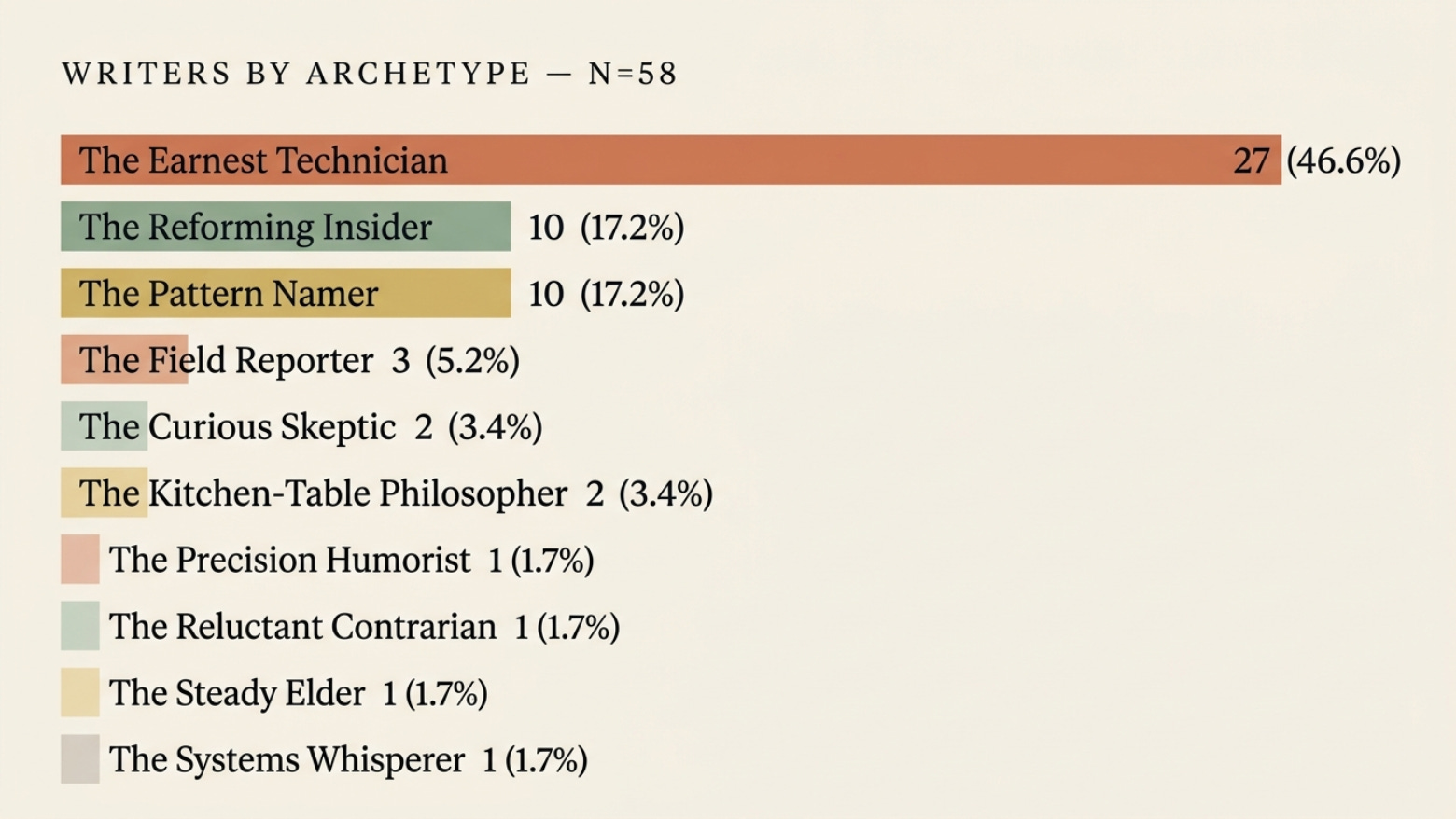
The Earnest Technician (n=27, 46.6%)
The corridor I live in. Voice traits: clinical precision with patient enthusiasm, dollar amounts and specific failures used as authority, sentences that hit then stop.
magazine.sebastianraschka.com

Most of these changes look like small tweaks in my architecture diagrams, but some of them are quite intricate design changes that are worth a more detailed discussion.
The voice of someone who wrote the textbook and is now annotating it for you in real time.
He flags the small changes before you would have noticed they mattered.
blog.bytebytego.com

An LLM without tools is a brain in a jar.
A whole technical concept compressed into seven words and a single image.
This is the move every Earnest Technician aspires to and almost none land.
newsletter.maartengrootendorst.com
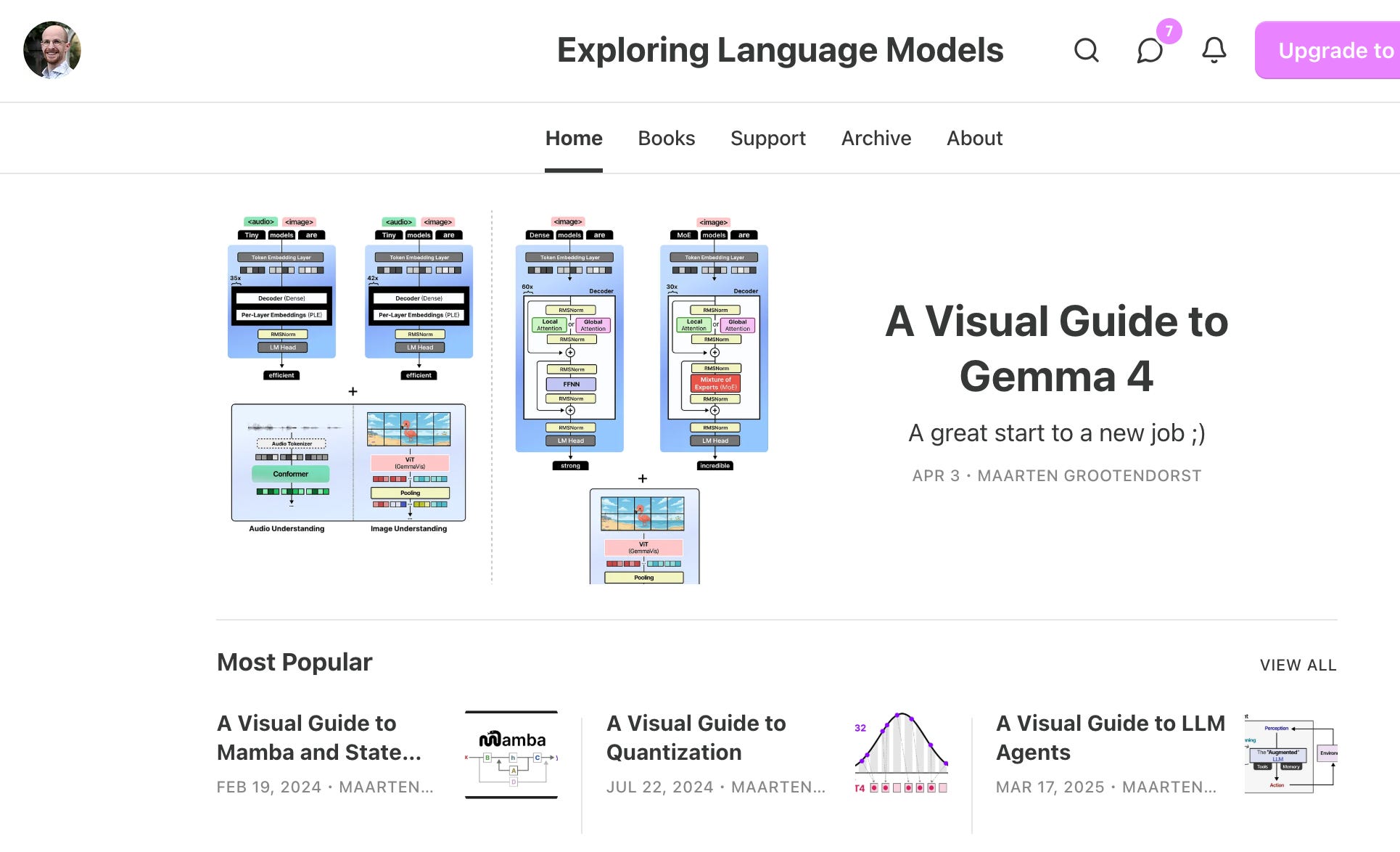
An intuition first approach through visual storytelling
Four italicized words that double as his brand and his epistemology.
He doesn’t teach concepts - he teaches the route concepts take from confusion to intuition.
www.interconnects.ai

If we’re not careful with the discourse around distillation, many people could associate this broad technique used for research and development of new models as an act at the boundary of corporate manipulation and crime.
The patient defense of a technical term against political distortion.
Lambert is what The Earnest Technician sounds like when stakes are high.
He doesn’t get louder. He gets more precise.
What you notice if you read across these: they are all doing the same thing structurally:
Open with a concrete recent observation.
State a contrarian-but-defensible claim.
Provide receipts.
Close with a specific action or admission.
The variation is in what they know, not how they say it.
The Reforming Insider (n=10, 17.2%)
Voice traits: someone who used to be on the inside of a thing, or is still inside but trying to fix it.
Authority comes from proximity, not credentials.
Tone is wry, sometimes exhausted, often urgent.
drjenniferlincoln.substack.com

Racism is not a poverty issue. It is a racism issue.
The two-beat correction is the move.
She doesn’t argue, doesn’t qualify, doesn’t acknowledge the comfortable euphemism. She replaces it.
The Reforming Insider voice at full strength: the only person allowed to make this kind of categorical claim is someone whose proximity to the problem makes the categorical claim defensible.
aigovernancelead.substack.com

“We have AI governance.” I hear this a lot. Then the engagement begins - and it’s ceremonial, not procedural.
Opens with the client’s own confident sentence, then dismantles it in one diagnostic word: ceremonial.
That’s the entire Reforming Insider playbook- let the inside speak, then name what was wrong with it.
erictopol.substack.com

Yet none of the extraordinary progress that has been published for superhuman vision of the retina has been incorporated into routine medical practice!
The exclamation point is the move. He’s not detached. He’s furious.
The Reforming Insider who’s still inside is allowed to be angry about the gap between what the evidence says and what the institution does.
experimentalhistory.substack.com

For someone like me, whose job is to produce words on the internet, it seemed like only a matter of time before I would have to fill my pockets with stones and wade into the sea.
The only writer in the sample who would smuggle a Virginia Woolf suicide image into a joke about AI.
The defection from academic psychology is what licenses the literary swing.
importai.substack.com

It’s a reluctant view because the implications are so large that I feel dwarfed by them, and I’m not sure society is ready for the kinds of changes implied by achieving automated AI R&D.
Confesses awe and stays analytical in the same sentence. “I feel dwarfed” is not a phrase The Earnest Technician permits themselves. Clark earns it because he’s been inside long enough to know what dwarfing actually looks like.
The pattern: these writers use “I used to think X” or “I’m watching X fail from the inside.”
The credibility move is the proximity.
The Earnest Technician proves expertise through receipts in the present.
The Reforming Insider proves it by naming what they once believed, or what they’re still fighting from within.
The Pattern Namer (n=10, 17.2%)
Voice traits: takes a recurring phenomenon and gives it a name that did not exist before. Coiner of frameworks. Big on labeled distinctions and one-line verdicts.
thezvi.substack.com

I realize we are incapable of keeping the AI in a box, but you would think we would be able to keep people on a ship.
The exhausted analogy is the brand. He doesn’t argue against the system.
He names it, dryly, and trusts you to feel the absurdity. The Pattern Namer at their most efficient: one sentence, two systems, one verdict.
thealgorithmicbridge.substack.com

Spite is a hell of a business strategy.
Six words that explain a corporate maneuver more clearly than the press release ever could. The Pattern Namer’s job is to give a human name to a structural thing.
Romero does it in six words.
www.exponentialview.co

The export controls have become capability-generating – labs in China are forced to be ruthlessly efficient.
Coins “capability-generating” in passing, like he didn’t even notice he’d named a category. Azhar’s Pattern Namer move is to drop the framework into a sentence about something else - the geopolitics is the surface, the systems-thinking is the engine.
www.notboring.co

turning Robinhood money into sci-fi energy and compute moonshots is exactly how you should billionaire.
“Billionaire” used as a verb. McCormick’s optimism isn’t naive. It’s a deliberate rhetorical position, The Pattern Namer who decided cheerfulness was a contrarian stance worth occupying.
The Pattern Namer’s superpower is making invisible things visible by labeling them. The risk is the framework becoming the writer’s whole personality. The best ones in the sample resist this.
The remaining 19% - the long tail
The Field Reporter (3), Curious Skeptic (2), Kitchen-Table Philosopher (2), Precision Humorist (1), Reluctant Contrarian (1), Steady Elder (1), Systems Whisperer (1).
The writers most worth knowing about.
The corridor produces consensus. The long tail produces canon.
astralcodexten.substack.com - The Curious Skeptic

If you read “Her lips were the whispering echo of a granite conundrum”, then it sounds literary as hell for the 0.5 seconds it takes before you realize it’s meaningless.
Invents a fake bad sentence, gives it a tossed-off probabilistic verdict (0.5 seconds), then moves on. Scott Alexander’s move is to be both rigorous and playful in the same clause. And to make you feel smart for keeping up.
benn.substack.com - The Precision Humorist
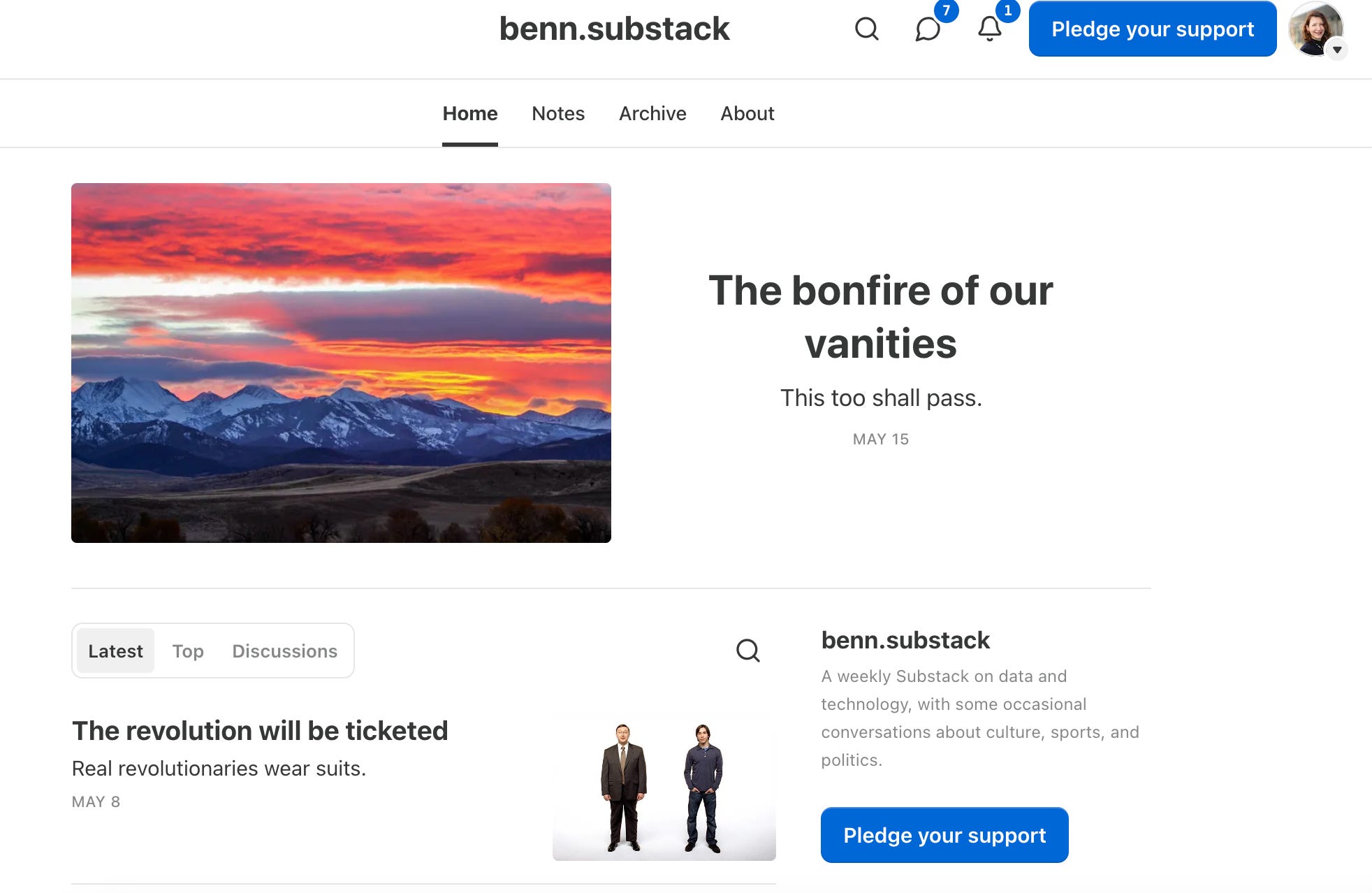
It is Jane Street, vibe coded.
The only writer in the sample who could put “vibe coded” next to “Jane Street” and make both funnier. Benn’s superpower is that the joke is also the analysis. You can’t extract the structure of the argument from the comedy - they are the same sentence.
garymarcus.substack.com - The Reluctant Contrarian

“they hadn’t figured out how OpenAI would pay for it” may turn out to be the epitaph for an entire era.
A damning quote weaponized into a tombstone. Marcus’s voice depends on you knowing he’s been saying this for years - the phrase “may turn out to be the epitaph” is unbearable from anyone who didn’t earn it. He earned it.
annehelen.substack.com - The Kitchen-Table Philosopher

And again, the people-pleaser in me feels like absolute garbage for asking people to do anything, anything at all, to access my writing and this community.
She admits she feels like garbage for asking, then asks anyway.
Petersen’s move, the one no Earnest Technician can copy, is to let her own discomfort become the connective tissue between her and the reader.
The vulnerability is the credential.
Two observations about the long tail:
These are mostly older publications. The Reluctant Contrarian and the Kitchen-Table Philosopher in particular tend to be writers who have been at it for a decade or more. The corridor seems to be a feature of newer Substack writers - and that suggests the corridor is acquired, not innate.
They take more risk per sentence. A Reluctant Contrarian sentence is structurally more dangerous than an Earnest Technician sentence. It might fall flat. It might land wrong. It invites an argument. The Earnest Technician sentence almost never falls flat. But it almost never goes viral either. The risk is the source of the reward.
Before you read further, run Voice Mirror on yourself.
It takes 60 seconds: substackvoice.com. Paste your URL, get your archetype and your signature line.
The rest of this article will hit differently if you’ve already seen your own result.
The six rejected poles in Part 2 will mean something specific.
Part 4 - where I ran the tool on myself twice - will read as a method, not a memoir.
I built Voice Mirror specifically so writers could do this.
The 58 publications I analyzed for this piece all came through the same tool.
Your result will be in the same vocabulary as the result I’m about to break down.
Part 2: The six rejected poles
In the free piece I named three near-tied anti-patterns: academic jargon (24.1%), literary flourish (17.2%), hype language (17.2%).
That was the surface. The rigorous version is six.
