
Stop Finding Common Ground: The Communication Trap That's Stalling Your ML Career
Why the advice you've been following about "connecting" is actually making you forgettable—and what to do instead

I watched a senior ML engineer completely tank his promotion interview last month.
He had everything on paper: published research, production models serving millions of users, glowing peer reviews. But when the VP asked him about handling a critical model failure, he responded with: “Oh, I totally get it—I’ve been in similar situations where...”
The VP’s face went flat. The energy died. The promotion went to someone else.
Here’s what nobody tells you about climbing the ML ladder: Your technical skills got you in the room. Your communication skills will either launch you forward or keep you stuck.
And that well-intentioned advice about “finding common ground”? It’s silently sabotaging your career.
The Common Ground Trap

Chris Voss, former FBI hostage negotiator, shares a story that every technical professional needs to hear. Picture 300 angry passengers stranded in LA, all scrambling for help. One passenger tries to help a fellow traveler who’s yelling at the gate agent by saying: “Hey man, we’re all in the same boat. None of us planned this...”
The response? “Go f*** yourself.”
When you share your common ground story, you feel phenomenal. You’re bonding. Connecting. Being empathetic.
But here’s the brutal truth: The other person feels their story being stolen.
This happens constantly in ML career conversations:
You: “I’m struggling with productionizing this recommendation system—”
Them: “Oh yeah, I had the same issue with our fraud detection model! What I did was...”
Your brain: Wait, I wasn’t done. This isn’t about you.

The Three Communication Styles Killing Your Career
Let me break this down for you:
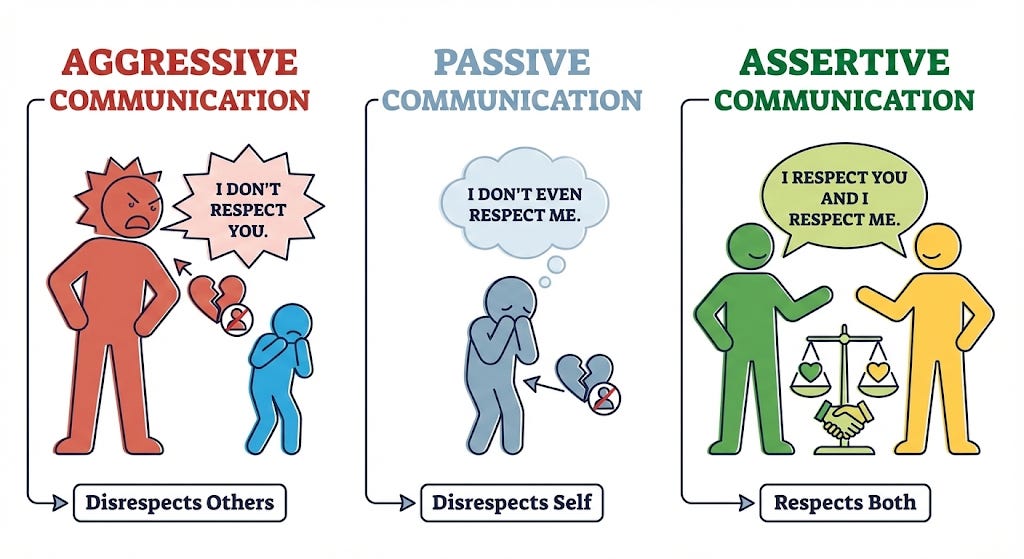
Aggressive communication says: “I don’t respect you.”
Interrupting stakeholders in design reviews
Dismissing non-technical concerns
“That’s impossible” without explanation
Passive communication says: “I don’t even respect me.”
Staying quiet when your model approach is better
Not pushing back on unrealistic timelines
Accepting credit for someone else’s work
Assertive communication says: “I respect you AND I respect me.”
“Here’s what the data shows, and here’s my recommendation”
“I need three more days to validate this approach properly”
“Let me understand your constraints first, then I’ll propose solutions”
The difference between aggressive and assertive? Aggressive shuts doors. Assertive opens them.
How This Shows Up In Your ML Career
From analyzing hundreds of ML interview prep sessions and career coaching conversations, here’s where technical professionals consistently get tripped up:
In Technical Interviews:
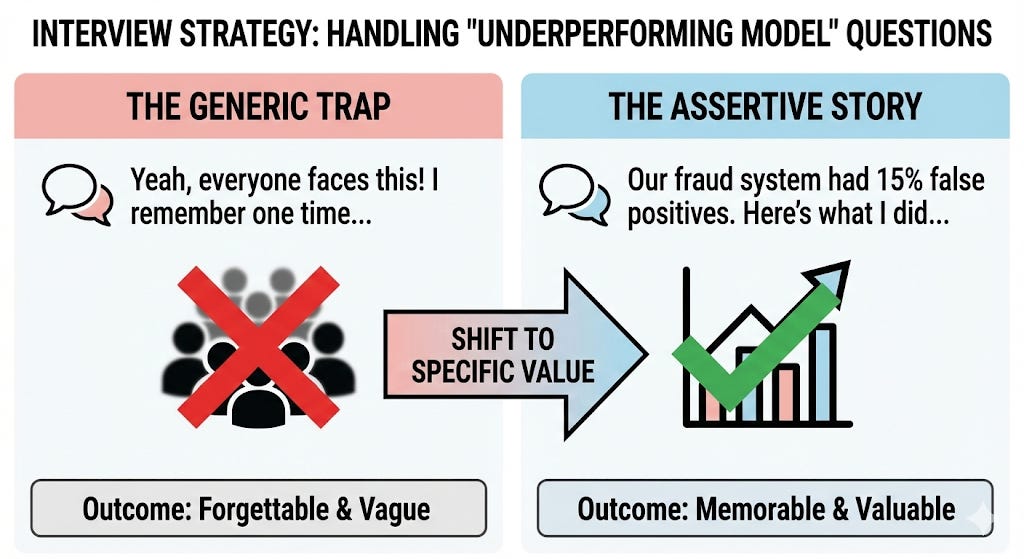
You’re asked: “Tell me about a time you dealt with an underperforming model.”
Common ground trap: “Yeah, every ML engineer faces this! I remember this one time...” (You just made it generic and forgettable)
Assertive storytelling: “Let me walk you through our fraud detection system that was letting 15% more false positives through. Here’s what I did...” (Now you’re showing specific value)
In Stakeholder Meetings:
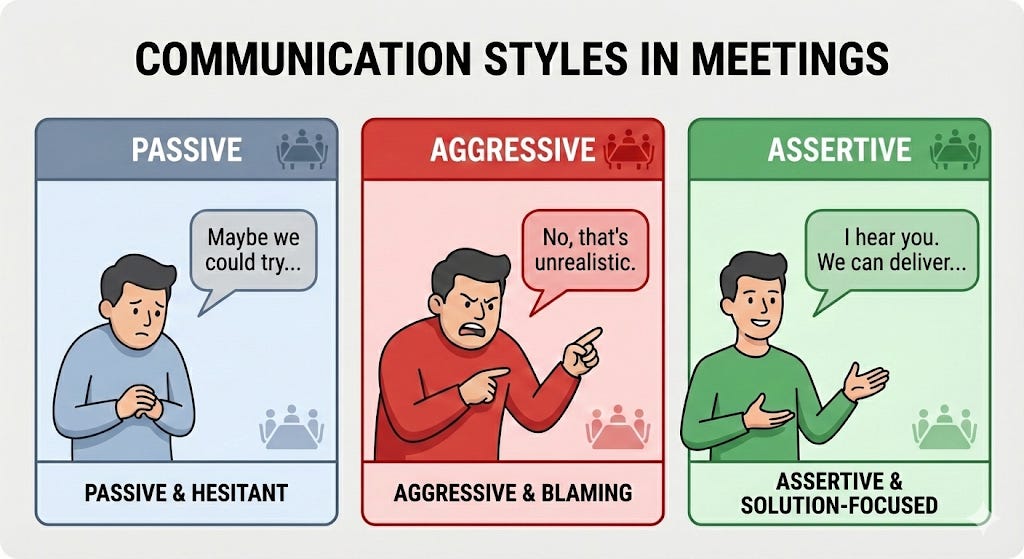
Passive: “Well, the model needs more data... but I guess we could try...”
Aggressive: “No, that timeline is unrealistic. You don’t understand ML.”
Assertive: “I hear the urgency. With our current data pipeline, we can deliver a baseline model in 2 weeks and iterate to full accuracy in 6. Here are the tradeoffs...”
In Promotion Conversations:
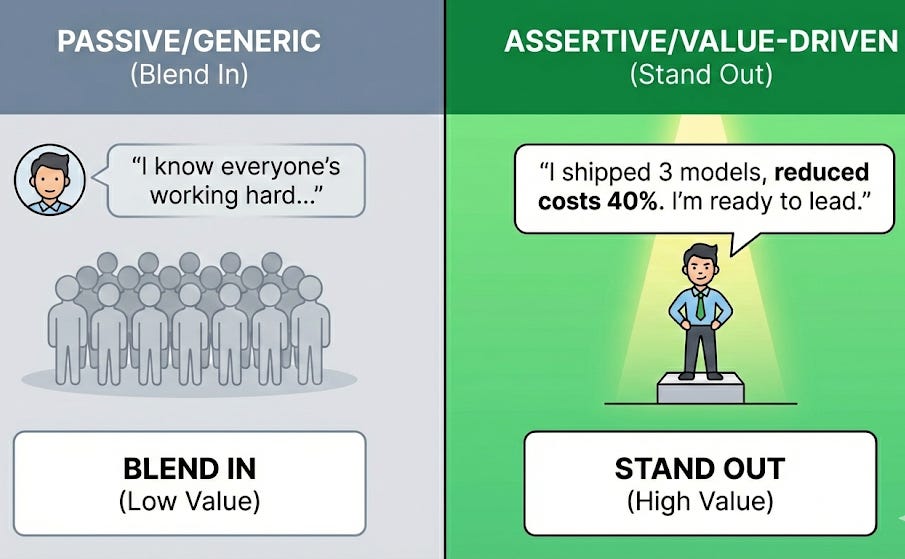
Common ground trap: “I know everyone’s working hard this quarter...” (You just made yourself blend in)
Assertive positioning: “I’ve shipped three production models this quarter that reduced our inference costs by 40%. I’m ready to take on the team lead role. Here’s how I see myself adding value...” (You just made yourself unmissable)
The Story Toolbox: Your Secret Weapon
Here’s what they don’t teach you in your ML bootcamp or CS degree: Your stories are your leverage.
Build your Story Toolbox with 3-5 specific examples using the CAR method:
Challenge: The friction detection model was missing 30% of anomalies
Action: I redesigned the feature engineering pipeline and implemented ensemble methods
Result: We improved detection by 45% and reduced false positives by 60%
Practice these stories until you can tell them in your sleep. Because here’s the thing: when that VP asks you about handling failure, or that hiring manager wants to know about your leadership style, or that skip-level meeting asks about your biggest impact—you need stories ready.
Not common ground. Not relatability. Stories that show value.
The Assertive ML Professional’s Playbook
Here’s your action plan:
1. Stop Story-Stealing When someone shares a challenge, resist the urge to jump in with “Yeah, I had that too!” Instead: “Tell me more about what you’re seeing” or “What have you tried so far?”
2. Build Your Story Toolbox Document 5 specific situations where you:
Solved a critical technical problem
Led without authority
Handled ambiguous requirements
Mentored someone effectively
Made a tough technical call
3. Practice Assertive Framing Replace: “Maybe we could...” With: “Based on the data, I recommend...”
Replace: “I’m not sure but...” With: “Here’s what I know and what I need to validate...”
4. Prepare for Skip-Level Meetings Don’t just update on your work—come with:
Specific questions about company priorities
Concrete examples of your impact
Clear asks for what you need
5. Master the Technical Interview Stop giving theory lectures. Start showing:
“Here’s the specific problem I faced”
“Here’s my systematic approach”
“Here’s the measurable outcome”
The Bottom Line
The ML field is full of brilliant people who know their algorithms, can code circles around others, and understand the math cold.
What separates the ones who advance from those who plateau?
Communication. Specifically, assertive communication.
Not aggressive (you’re not the smartest person in the room, even when you are). Not passive (your insights deserve to be heard). Assertive (you respect yourself and others enough to speak with clarity and conviction).
Your next promotion isn’t waiting for you to become a better engineer.
It’s waiting for you to become a better communicator.
Your Next Step: Open your notes app right now. Write down ONE specific story from the last 6 months where you solved a meaningful problem. Use the CAR method. Practice telling it in 90 seconds.
Share it in the comments and I will help you perfect it.
This is your Story Toolbox foundation.
Teodora Szasz is a career coach specializing in helping ML engineers and data scientists accelerate their careers. Through Standout Systems, she provides coaching, resources, and frameworks for technical professionals ready to lead.