
Stop Negotiating Like You're Fighting. Start Negotiating Like a Problem-Solver.
Why the smartest AI/ML professionals leave money, growth, and opportunities on the table—and how to fix it.

In 2025, I got laid off and hired within the same week.
That sounds dramatic, but here’s what actually happened: I wasn’t scrambling. I wasn’t panicking. I was negotiating—and not the way most people think about negotiation.
When the layoff news came, I didn’t beg to keep my job. When the new offer came in three days later, I didn’t accept the first number. Instead, I did something that felt counterintuitive at the time:
I stopped trying to “win.”
And that’s exactly why I won.
The Biggest Lie in Tech Negotiation
Most of us approach salary negotiations, project discussions, or even team conflicts like we’re in a zero-sum game.
You vs. the hiring manager.
Your raise vs. the budget.
Your promotion vs. your colleague’s.
But here’s what negotiation experts like Robert Mnookin (Harvard Law professor and author of Beyond Winning) have spent decades proving:
The best negotiators don’t try to win. They try to create value.
This isn’t soft. It’s not “being nice.” It’s actually the hardest, most strategic thing you can do.
The Three Tensions Every Tech Professional Must Master
After studying negotiation frameworks and applying them through 17+ years in AI/ML—from a PhD in France, to building teams at the University of Chicago, to leading AI projects in healthcare—I’ve realized that every negotiation we face contains three hidden tensions.
Master them, and you’ll never leave money on the table again.
Tension #1: Creating vs. Distributing Value
Here’s a story I love from negotiation research.

Two siblings fight over an orange. They compromise, cut it in half.
One eats the fruit and throws away the peel.
The other uses the peel for baking and throws away the fruit.
They both got half of what they could have had—because they never asked what the other person actually wanted.
In your career, this happens constantly:
You negotiate for a higher salary when what you really want is remote flexibility
Your manager offers you a title bump when what you need is learning opportunities
Your company proposes a retention bonus when you’re actually leaving for better problems to solve
The solution? Stop asking “What do I want?” and start asking “What do they have that I might value? What do I have that they might value?”
When I was negotiating my transition from academia to industry in 2023, I could have fought for the highest possible base salary. Instead, I asked: What does this company value that I can provide uniquely? What do they have that’s valuable to me beyond cash?
The answer: access to massive cardiac datasets (I was obsessed with clinical AI), a clear path to first-author publications, and flexibility to continue my coaching work on the side.
I traded some salary negotiation leverage for those things. Within a year, I had published AI research in JASE and built my coaching business alongside my full-time role.
That wasn’t compromise. That was creating value that didn’t exist before the negotiation started.
Tension #2: Empathy vs. Assertiveness
Here’s where most technical people get stuck.
We’re trained to be assertive—to defend our models, justify our approaches, prove our code works. But pure assertiveness in negotiation often backfires.
Conversely, many of us (especially women in tech, and yes, I’ve lived this) swing to pure empathy. We listen, we understand, we accommodate—and we walk away with less than we deserved.
The magic is holding both.
Assertiveness without empathy → Conflict escalation, broken relationships
Empathy without assertiveness → You get exploited
What this looks like in practice:
When I built and led my AI team at the Research Computing Center, I had to negotiate constantly—for GPU resources, for collaborator time, for research directions. My breakthrough came when I stopped treating these as battles.
Instead of: “We need the A100 cluster time—our project is higher priority.”
I’d say: “Help me understand what’s blocking your timeline. What would make this easier for your team? And here’s what my team needs to hit our goals...”
That approach helped me secure $200K+ in Google Cloud credits, NVIDIA cluster support, and a Lenovo/Intel collaboration for multiparametric MRI research.
Same underlying interests. Completely different outcome.
Tension #3: Principal vs. Agent
This one’s sneaky, and it applies even when you’re not hiring a lawyer or recruiter.
Anytime someone negotiates on your behalf, their interests aren’t perfectly aligned with yours.
Your recruiter gets paid when you accept—not when you get the best deal
Your manager might advocate for your promotion, but they’re also managing headcount
Your mentor might advise you to stay, because they benefit from your presence
This isn’t malicious. It’s human.
The fix:
Always know your own BATNA (Best Alternative to a Negotiated Agreement). When I got laid off, I knew exactly what my alternatives were. That clarity is power.
Never fully outsource your negotiation. Even with a recruiter handling details, stay in the loop. Ask questions. Verify information independently.
Understand the other side’s agents. When negotiating with a company, you’re often talking to HR—not the hiring manager, not the CFO. What are HR’s incentives? Usually: fill roles quickly, minimize drama, stay within budget bands. Knowing this changes how you frame requests.
The Framework That Changed My Career
Here’s the practical system I use now—whether it’s salary, scope, resources, or team dynamics:
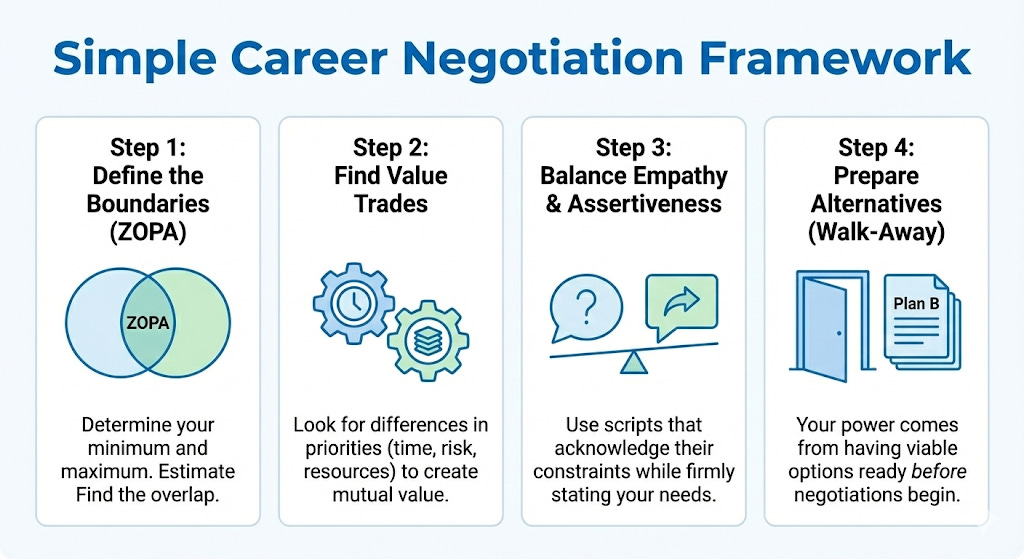
Step 1: Map the Zone of Possible Agreement (ZOPA)
Before any negotiation, answer:
What’s my minimum acceptable outcome? (Reservation value)
What’s the best I can realistically hope for?
What’s their minimum? Their ceiling?
If there’s no overlap, the negotiation can’t succeed—and knowing that early saves everyone time.
Step 2: Hunt for Value-Creating Differences
Ask yourself:
Do we have different resources? (Maybe they have data I need; I have expertise they need)
Different risk tolerances? (I might take equity instead of salary if they’re cash-strapped)
Different time preferences? (I can start later if they can offer a signing bonus)
Different forecasts? (If I believe the project will succeed, I’ll accept performance bonuses)
Every difference is a potential trade that makes both sides better off.
Step 3: Practice Empathy + Assertiveness Together
Script your key phrases:
“Help me understand what’s driving that constraint...”
“Here’s what would make this work really well for me...”
“What if we tried...”
Notice how none of these are adversarial? But all of them are assertive.
Step 4: Know Your Walk-Away
The most powerful word in negotiation is “no.”
But you can only say it credibly if you’ve prepared alternatives. This is why I always tell my coaching clients: Your negotiating power is built in the months before the negotiation, not during it.
Build your skills. Maintain your network. Track your accomplishments. Keep your resume warm.
When I got that layoff notice in 2025, I had all of this in place. The new offer came fast—not because I was lucky, but because I’d been preparing for years.
Your Negotiation Homework
This week, pick one upcoming conversation where something is at stake—a project scope discussion, a performance review, even a team resource allocation.
Before the meeting, write down:
What’s my BATNA? (If this doesn’t go well, what’s my alternative?)
What do I value that they might provide easily?
What do they value that I could provide easily?
What’s one empathetic question I can ask to understand their constraints?
What’s one assertive statement I can make about my needs?
Then notice what changes.
The Bigger Picture
Here’s what I’ve learned across 17 years of negotiating—from PhD committees in Toulouse, to research resource battles at UChicago, to industry offers in Silicon Valley:
The negotiators who “win” the most consistently are the ones who help the other side win too.
This isn’t idealism. It’s game theory. It’s economics. It’s backed by decades of research from Harvard, Stanford, and everywhere serious people study negotiation.
And more importantly—it works.
When you stop fighting and start problem-solving, you don’t just get better deals. You build better relationships, better reputations, and better careers.
What’s one negotiation you have coming up? Hit reply and tell me—I’d love to help you think through it.
And if you found this useful, share it with someone who’s about to negotiate their next offer. They’ll thank you.
Teodora is an AI/ML leader and career coach helping technical professionals navigate their careers with confidence. She writes weekly at teodoracoach.substack.com.
Grab her free guides on acing ML interviews, building your brag list, and negotiating your worth at teodora.coach.
P.S. — If you’re preparing for AI/ML interviews and want specific frameworks for technical and behavioral rounds, check out my previous deep dives on probability, coding, and system design. Your next negotiation starts with proving you’re worth negotiating for.
Love Step 3. Think we don't talk enough about this.
Thank you for appreciating John! Assertiveness and empathy together are a very powerful combo 🌞 let's normalize talking about it