
The Counterintuitive Reason Top AI Scientists Produce More by Doing Less
Why slowing down is the most powerful career move you can make in 2026 - and 5 ways to start this week.

Here’s something that should worry you: the average knowledge worker checks email or Slack once every six minutes.

That means there is essentially no sustained thinking happening during a typical workday. None. And if your job is building machine learning models, designing clinical AI pipelines, or solving problems that require deep cognition - this is an emergency.
I know, because I lived it.
When I was building and leading my AI team at the University of Chicago Research Computing Center - juggling multimodal CNN research for prostate MRI, mentoring 10 researchers, running SLURM jobs on A100 GPUs, and writing papers - I hit a wall. Not because the work was too hard. Because there was too much of it at the same time. And the most dangerous part? I looked productive. Slack messages flying. Meetings stacked. Papers in progress.
But my best work - the research that ended up in peer-reviewed journals, the COVID-19 predictor that earned a Google TPU grant, the clinical imaging tools that RSNA actually used - all of that came from periods when I deliberately slowed down and went deep on one thing.
This article is going to show you exactly how to do that, whether you’re an ML engineer, a data scientist, a researcher, or a healthcare AI professional. By the end, you’ll have a concrete system for producing work that actually gets you noticed - while feeling less frantic.
The Burnout Trap in AI/ML (And Why It’s Getting Worse)
A recent Forbes study found that 66% of professionals report feeling burnt out - an all-time high. In AI and ML specifically, the pressure is even more acute. New papers drop daily. New frameworks every week. The field moves so fast that people confuse keeping up with noise with doing meaningful work.
Here’s the uncomfortable truth: most of what feels productive in an AI/ML career is actually pseudo-productivity - visible activity that generates almost no real value. Responding to every Slack thread. Attending every standup. Saying yes to every “quick” analysis request. Reviewing code you weren’t asked to review because you want to be helpful.
You’re paying what I call the busyness tax: the hidden cost of doing so many things simultaneously that none of them get the quality of thought they deserve.
And the data backs this up. Microsoft found that time spent in digital meetings increased by 250% during the pandemic - and it hasn’t come back down. That’s time that could have gone toward the deep, focused work that actually advances your models, your papers, and your career.
The Three Principles That Changed How I Work
After years of trial and error - from my PhD in France, to the Research Computing Center, to building clinical AI at Philips - I’ve distilled my approach to what I call Deep-First Productivity. It’s inspired by principles that the most impactful scientists and creators in history have used, and it comes down to three things:
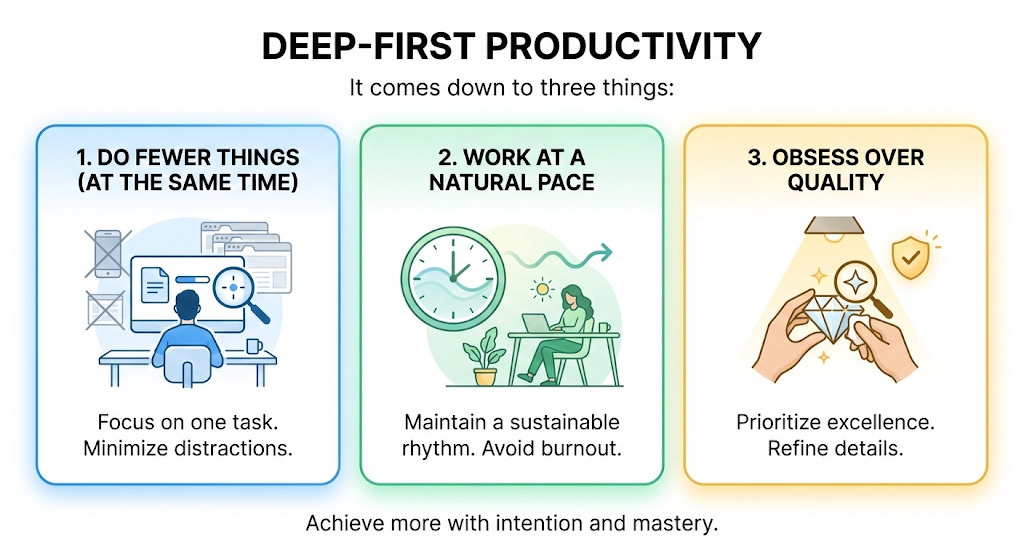
These aren’t soft ideas. They’re operational strategies. Let me show you what each looks like in an AI/ML career.
Principle 1: Do Fewer Things (At the Same Time)
This does not mean be less ambitious. It means stop running five experiments, three collaborations, and two paper drafts simultaneously while also answering 47 Slack messages about data pipelines.
Think about it this way: when I co-developed EchoJEPA - trained on 18 million echocardiography videos across 300K patients, now the world’s best video model for echo - that didn’t happen because I was multitasking. It happened because the team created space for sustained, deep focus on one hard problem.
Here’s how to apply this:
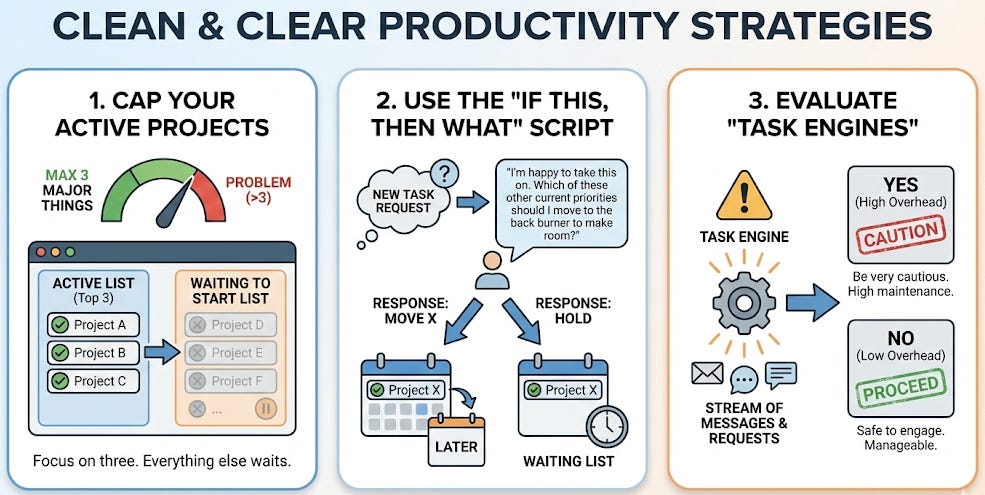
Cap your active projects. Right now, write down everything you’re working on. If it’s more than three major things, you have a problem. Put everything beyond the top three into a “waiting to start” list. The key insight: if a project is on your waiting list, you do zero email, Slack, or meetings about it. It generates no overhead until you pull it into your active queue.
Use the “if this, then what” script. When your manager asks you to take on something new, say: “I’m happy to take this on. Which of these other current priorities should I move to the back burner to make room?” This isn’t pushback—it’s professional clarity. It shows you’re strategic, not just busy.
Evaluate “task engines.” Before agreeing to any new commitment, ask: will this generate a stream of unscheduled messages and requests? If yes, be very cautious. A task engine (like leading an internal committee) will eat your deep work time alive. Prefer commitments that let you concentrate in blocks.
Principle 2: Work at a Natural Pace
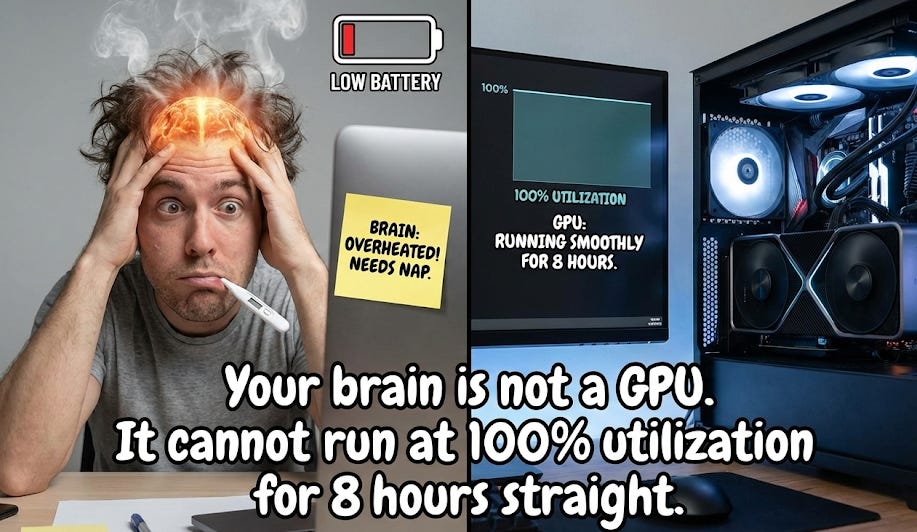
Your brain is not a GPU. It cannot run at 100% utilization for 8 hours straight. And yet that’s exactly what most AI/ML professionals try to do.
The best work in history - from Newton’s laws to breakthroughs in medical imaging -happened in cycles of intense focus followed by genuine rest. Not “rest” where you scroll through arXiv on your phone. Actual cognitive recovery.
Here’s what this looks like in practice:
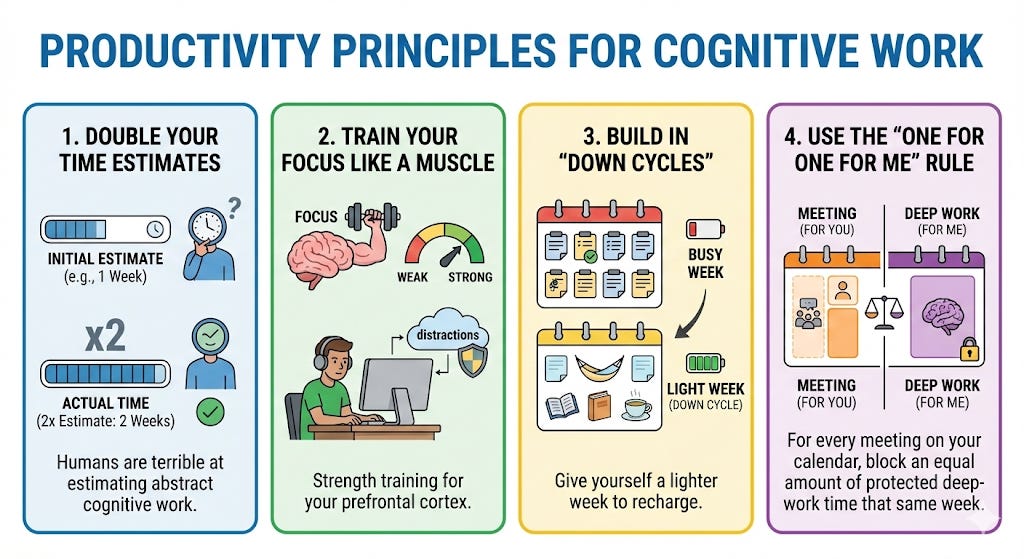
Double your time estimates. If you think a model retraining and evaluation will take a week, plan for two. Humans are terrible at estimating abstract cognitive work. When I was building our HIPAA-compliant data pipeline at Philips - scaling from 25K to 100K+ echo studies—the engineering was complex enough that rushing would have created technical debt we’d still be paying off. Giving it proper time meant we cut ingestion time by 60% and built something durable.
Train your focus like a muscle. Set a timer for 20 minutes. Work on one thing with zero distractions - no Slack, no email, no “quick checks.” When 20 minutes feels comfortable, push to 30. This is literally strength training for your prefrontal cortex. You will be shocked at how much more you accomplish in a focused 90-minute block than in a scattered 4-hour afternoon.
Build in “down cycles.” Some of the best software teams alternate three weeks of intense work with one week of lighter administrative and learning tasks. You can adapt this to your own schedule. After shipping a major deliverable - a model validation, a paper submission, an FDA regulatory package - give yourself a lighter week. Read papers. Refactor code. Mentor someone. Let your brain recover.
Use the “one for you, one for me” rule. For every meeting on your calendar, block an equal amount of protected deep-work time that same week. Non-negotiable. This is how you guarantee that meetings don’t consume 100% of your cognitive energy.
Principle 3: Obsess Over Quality
Here’s the career hack nobody talks about: when you produce genuinely high-quality work, you gain autonomy. Your manager trusts you more. Your collaborators defer to your judgment. You get to shape your own schedule because people want your best thinking, not just your availability.
Quality is what turned my prostate MRI research into a peer-reviewed publication with AUC 0.87. Quality is what led to the Women in AI North America Award. Quality is what gets 10+ patents filed. None of that comes from being the fastest person to respond on Slack.
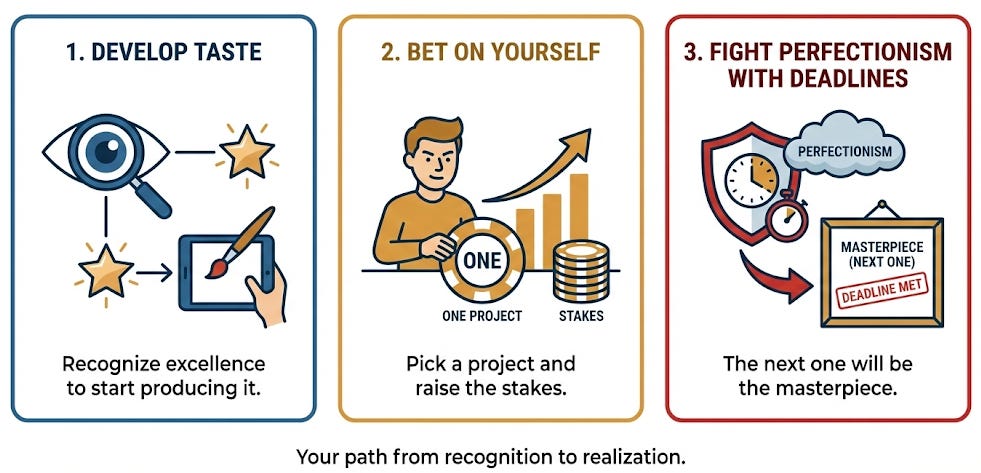
Develop taste. Study the best work in your subfield. Read papers not just for methods, but for how they communicate ideas. Look at how top researchers structure their experiments. When you can recognize what great looks like, you start producing it.
Bet on yourself. Pick one project and raise the stakes. Submit to a top-tier venue instead of a workshop. Pitch your work for a talk at a major conference. Commit to writing up that side project as a proper paper. Social pressure - the good kind - is rocket fuel for quality. When I committed to presenting our HPC deployment at Supercomputing 2019, it forced me to polish work that otherwise might have stayed as internal tooling. That visibility opened doors I didn’t expect.
Fight perfectionism with deadlines. Obsessing over quality is not the same as perfectionism. Perfectionism paralyzes you. Quality pushes you forward. The antidote? Set deadlines with other people involved. Tell a collaborator you’ll have the draft by Friday. Submit the abstract before you feel “ready.” My mantra: the next one will be the masterpiece. This gives your current project permission to be excellent without being perfect.
Your Action Plan for This Week
You don’t need to overhaul your life. Start with three moves:
1. The Audit. Grab a piece of paper. Write down every active project, commitment, and ongoing obligation. Circle the top three that will actually move your career forward. Everything else goes on a waiting list—starting now.
2. The Block. Open your calendar and block two 90-minute deep-work sessions this week. Treat them like you’d treat a meeting with your VP. During these blocks: phone in another room, Slack closed, email closed. One task only.
3. The Slow Friday. Block off Friday afternoon. No meetings. No Slack catch-up. Use it for a “lunch-hour project”—study a new technique, read a paper outside your usual domain, sketch an idea you’ve been sitting on. This is where your next breakthrough lives.
The Paradox That Changes Everything
Here’s what I’ve learned across a decade of building AI systems in healthcare, from my PhD in Toulouse to FDA-cleared products at Philips: the people who produce the most valuable work are not the busiest people in the room. They’re the ones who protect their focus like it’s a scarce resource - because it is.
Slowing down isn’t about doing less with your career. It’s about doing more of what matters.
Your model’s AUC doesn’t care how many Slack messages you sent today. Your paper’s impact factor doesn’t care how many meetings you attended. Your career trajectory doesn’t reward busyness - it rewards results.
Protect your deep work. Fewer things, done better, at a sustainable pace.
That’s the system.
Found this useful? Share it with a colleague who’s drowning in meetings and Slack notifications. They need this more than another standup invite.
And if you want personalized help building a career system that actually works for you - whether you’re navigating a job search, leveling up technically, or figuring out your next move in AI/ML—let’s talk: teodora.coach
Teodora Szasz is a Senior Clinical Data Scientist, AI/ML expert, career coach, and Women in AI Award winner. She writes Standout Systems to help AI/ML professionals build careers they’re proud of.