
Why 300 Applications Got Zero Interviews (And What Actually Works)
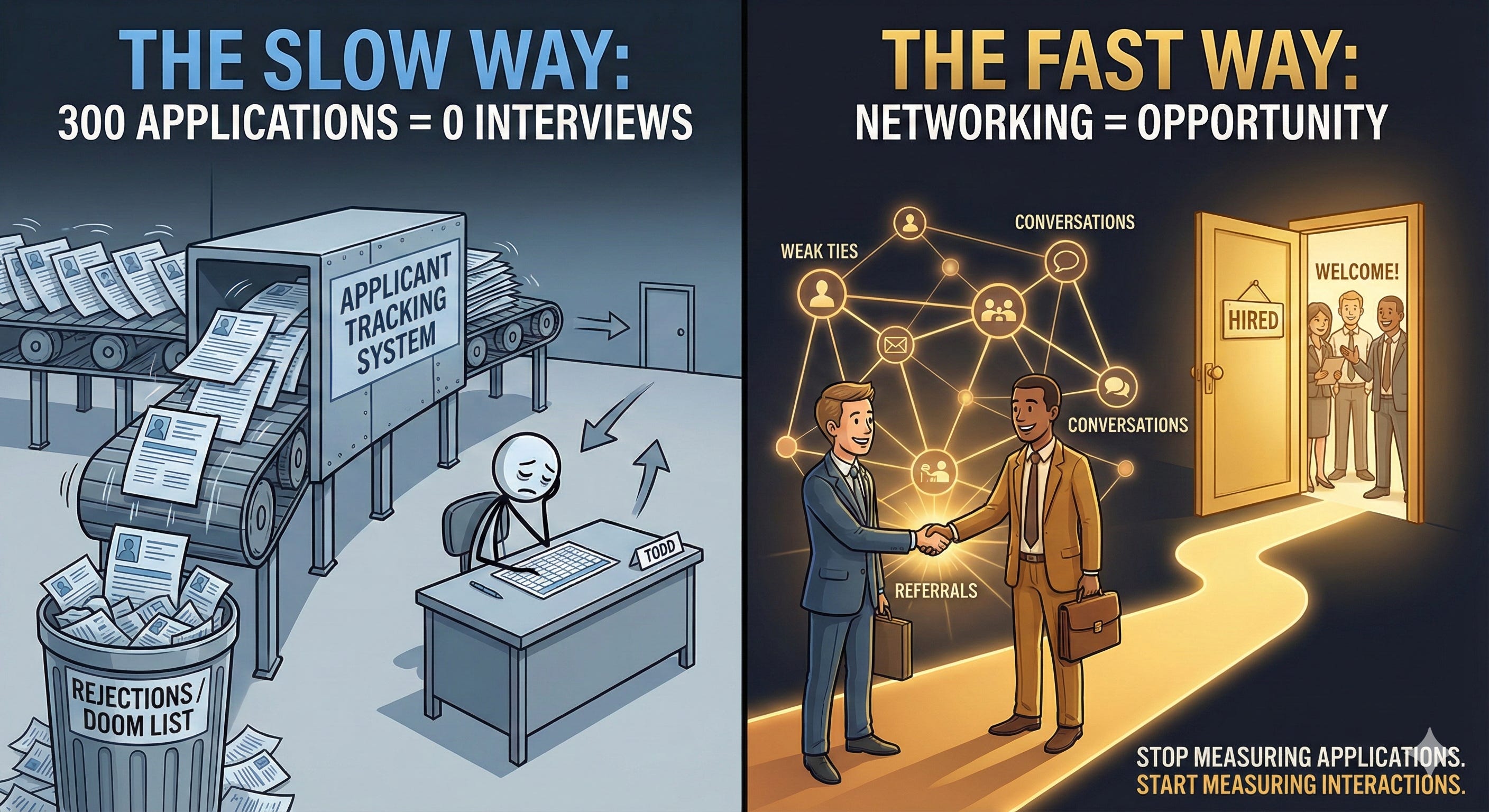
Applying online is the slow way. Networking is the fast way.

Todd applied to over 300 jobs.
Full forty-hour weeks. Spreadsheets tracking every submission. What started as an organization tool became what he called “a doom list of rejections.”
Zero interviews.
This isn’t a failure story. It’s a data story. And the data says something most job seekers don’t want to hear:
Applying online is the slow way. Networking is the fast way.
The Math That Changes Everything
Here’s what happens when you hit “submit” on most job applications:
Your resume enters an Applicant Tracking System (ATS). It gets scored by algorithms looking for keyword matches. If you pass that filter, you join a pile of potentially hundreds of other candidates. A recruiter — often managing 20+ open roles — spends an average of 6-7 seconds scanning your resume.
Your odds? Roughly 2-3% for a callback at competitive companies.
Now compare that to a referral.
When someone inside the company submits your application or emails the hiring manager directly, you bypass the ATS lottery entirely. Your resume lands in a much shorter pile. And here’s the real magic: you come pre-vetted.
The hiring manager’s subconscious thought: “If Sarah vouches for this person, they’re probably worth talking to.”
The Counterintuitive Truth About Your Network
Stanford sociologist Mark Granovetter discovered something that changed how we understand job searching: weak ties matter more than strong ties.
Your close friends and family move in the same social circles you do. They know the same opportunities, the same people, the same information.
But that former colleague you haven’t spoken to in two years? The person you met at a conference? The connection who liked your LinkedIn post last month?
They have access to entirely different networks. Different job openings. Different hiring managers. Different information.
This is why networking feels uncomfortable for many people — especially in technical fields. It requires reaching out to people you don’t know well. And that feels awkward.
But awkward is where opportunities live.
Stop Measuring Applications. Start Measuring Interactions.
Here’s the mindset shift that separates job seekers from job shoppers:
Instead of asking “How many applications did I submit this week?” ask:
How many people at my target companies did I talk to?
How many people in my network know I’m looking?
How many conversations did I have where I casually mentioned my professional interests?
The more interactions you log, the faster you land.
And here’s the key: even if you apply online, you’re not done. Every application should be followed by an attempt to connect with someone at the company — the hiring manager, the recruiter, or someone on the team.
The Golden 20 Exercise
Don’t know where to start? Try this:
Write down 20 people in your existing network who might be able to help your job search. Not necessarily people who can hire you — people who might know people, or have useful information, or work at companies you’re interested in.
Score each person on two dimensions:
Helpfulness: How likely are they to actually help if you reach out?
Influence: How connected are they to opportunities you want?
Start with high-helpfulness, high-influence contacts. Then work your way through the list.
Most people never do this exercise. They either network randomly or not at all. Having a system changes everything.
The 60 Seconds of Value Strategy
Here’s why most networking fails: people ask for things before they give anything.
Flip the script. Before every networking conversation, ask yourself: What can I offer this person in 60 seconds or less?
This could be sharing a relevant article, making an introduction, offering a skill you have, or simply asking thoughtful questions that show genuine curiosity about their work.
When you lead with value — even small value — you transform the dynamic. You’re not a job seeker asking for favors. You’re a professional building a relationship.
The Sponsor vs. Mentor Distinction
As you build relationships, understand what you’re building toward.
Mentors talk to you. They help you develop skills, navigate challenges, and think through your career. They can be at any level, at any company.
Sponsors talk about you. They advocate for you when you’re not in the room. They put their own reputation on the line to create opportunities for you. They’re typically senior to you, at your company.
Both are essential. But sponsors shape careers in ways mentors can’t.
The catch? You can’t just ask someone to be your sponsor. Sponsorship is earned through relationship-building and demonstrated excellence over time. As Carlo Dela Fuente from Cisco puts it: “A lot of that is done through relationship building. It takes time and effort… It’s not an overnight thing.”
Your Action Plan for This Week
Identify your Golden 20. Write down 20 people who could potentially help your career — whether you’re actively job searching or not.
Reach out to 3 people this week. Not to ask for anything. Just to reconnect, share something valuable, or express genuine interest in what they’re working on.
Change your metric. If you’re job searching, stop counting applications. Start counting conversations.
Audit your sponsor pipeline. Who are 2-3 senior people at your company who know your work? What could you do to strengthen those relationships?
The Bottom Line
The professionals who consistently land great opportunities aren’t necessarily the most technically skilled. They’re the most connected.
Not in a sleazy, transactional way. In a genuine, value-creating, relationship-building way.
Your network isn’t something you build when you need a job. It’s something you cultivate continuously — so that when opportunities arise, they find their way to you.
As one chief product officer said after being laid off: “Our networks are about to blossom.”
Make sure yours already has.
What’s one relationship you’ve been meaning to nurture but haven’t? Comment and tell me — accountability helps.