
Why DeepSeek's "Boring" Fix Is Outsmarting Billion-Dollar Models
They didn't add more data, more compute, or more parameters. They added a mathematical constraint. Here's the deep dive.

The Problem Nobody Saw Coming
Every ML engineer learns this early: depth is hard.
As neural networks grow deeper, information passes through hundreds of transformations. Each layer slightly distorts the signal. Over 100+ layers, those tiny distortions compound into catastrophic failure:
Gradients vanish or explode
Training destabilizes mid-run
Loss spikes without warning
Residual connections (ResNets, 2015) solved this elegantly. Instead of forcing each layer to completely rewrite its input, they let layers add to what’s already there:
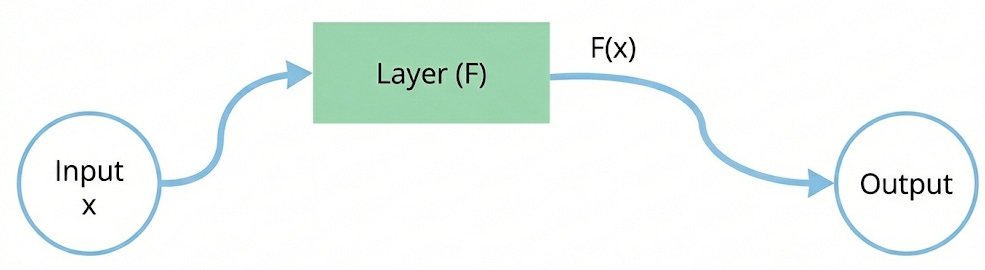
This created an identity path—a guaranteed highway where signals and gradients could flow without interference.
It worked so well that residual connections became the backbone of every Transformer. GPT, BERT, LLaMA—all of them are built on this principle.
Then researchers got ambitious.
The Flexibility Trap: Hyper-Connections
The question was natural: What if we had multiple highways instead of one?
Hyper-Connections introduced exactly that—multiple parallel residual streams where layers could:
Read from several streams simultaneously
Mix information between them
Write back in flexible, learnable ways
At small and medium scale? It worked beautifully. More expressivity. Better performance. Minimal extra compute.
At 27 billion parameters? Chaos.
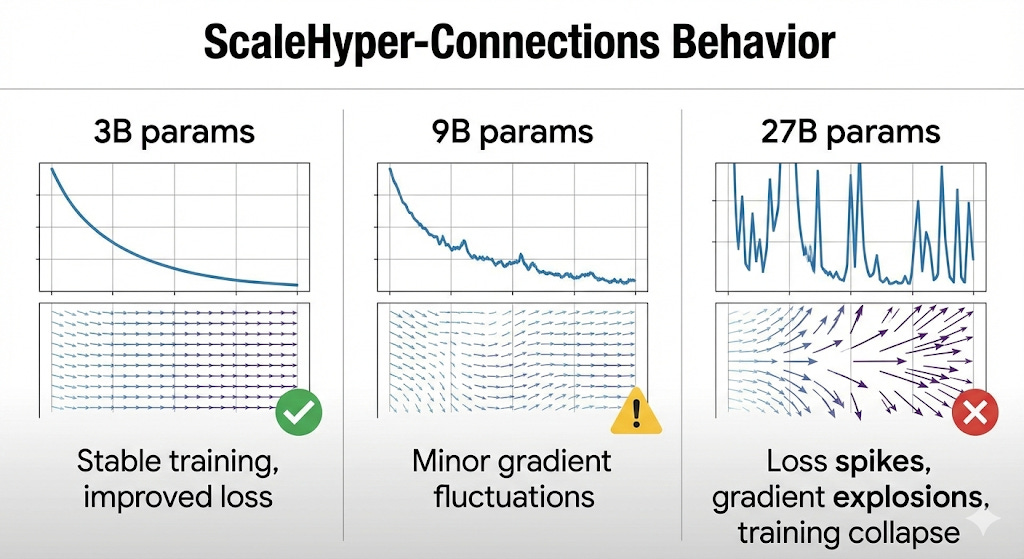
The problem: unconstrained mixing matrices.
Each layer learned to freely combine residual streams. Over hundreds of layers, small imbalances compounded:
Some streams accumulated exponentially more signal
Others faded to near-zero
The identity guarantee—information can always pass through unchanged—was broken
DeepSeek’s Insight: The Right Constraint
DeepSeek’s paper asks a different question:
What if we kept the multiple highways but enforced traffic rules?
Their solution—Manifold-Constrained Hyper-Connections (mHC)—restores one fundamental principle:
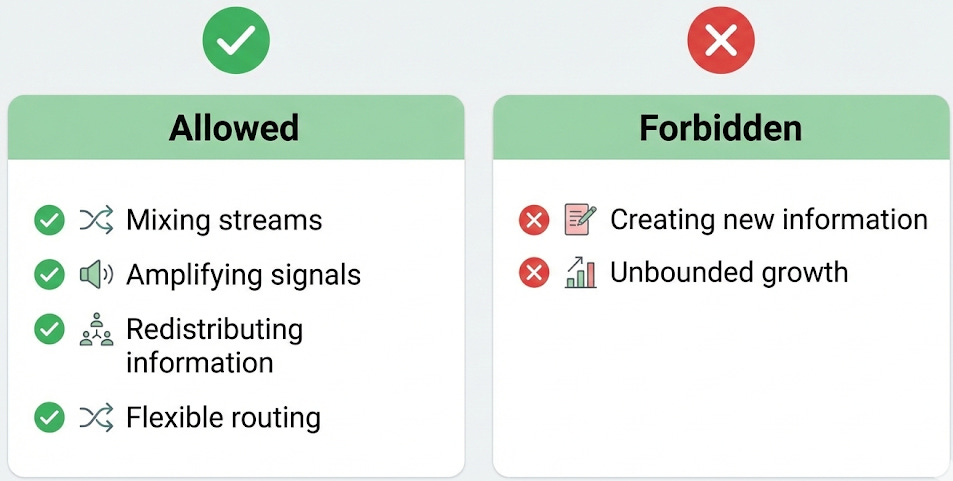
The mathematical enforcement: constrain all mixing matrices to be doubly stochastic.
The Math That Makes It Work
A doubly stochastic matrix has two properties:
All entries are non-negative
Every row sums to 1 AND every column sums to 1
Example (3 residual streams):
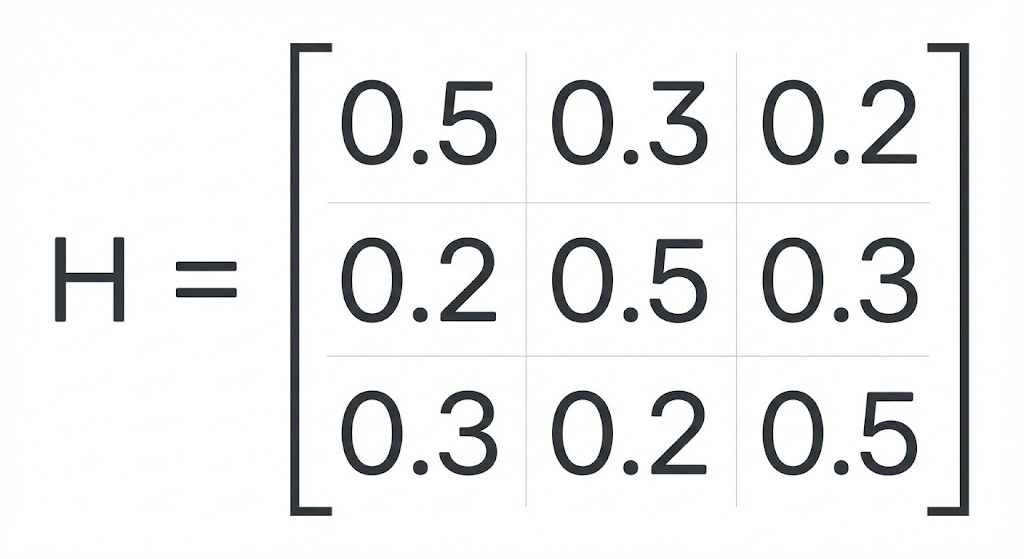
Why this works:
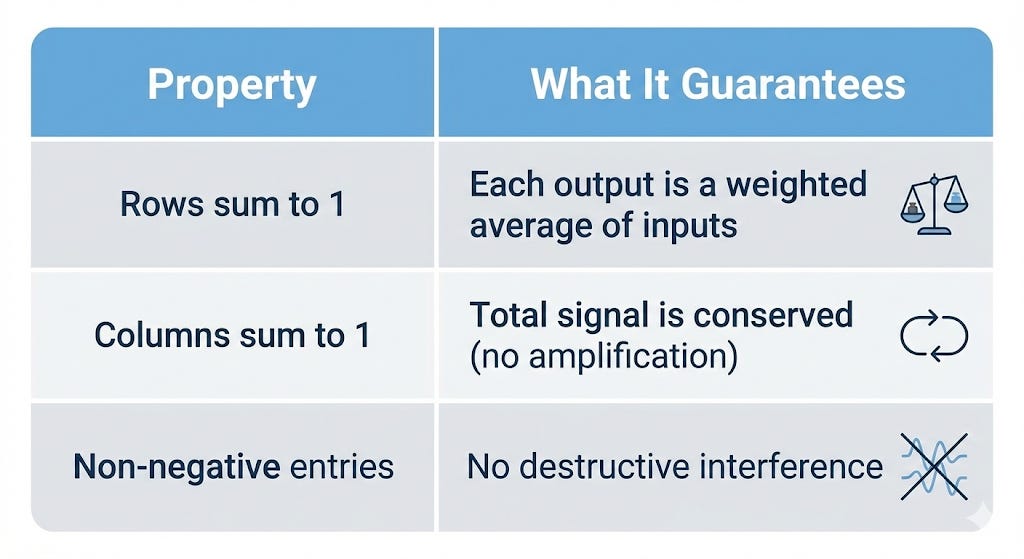
The geometric interpretation: These matrices live on the Birkhoff polytope—a specific mathematical manifold. By constraining mixing to this space, DeepSeek ensures that no matter how many layers you stack, the composition of mixing matrices remains stable.
This is the “manifold” in Manifold-Constrained Hyper-Connections.
The Results: Stability + Performance
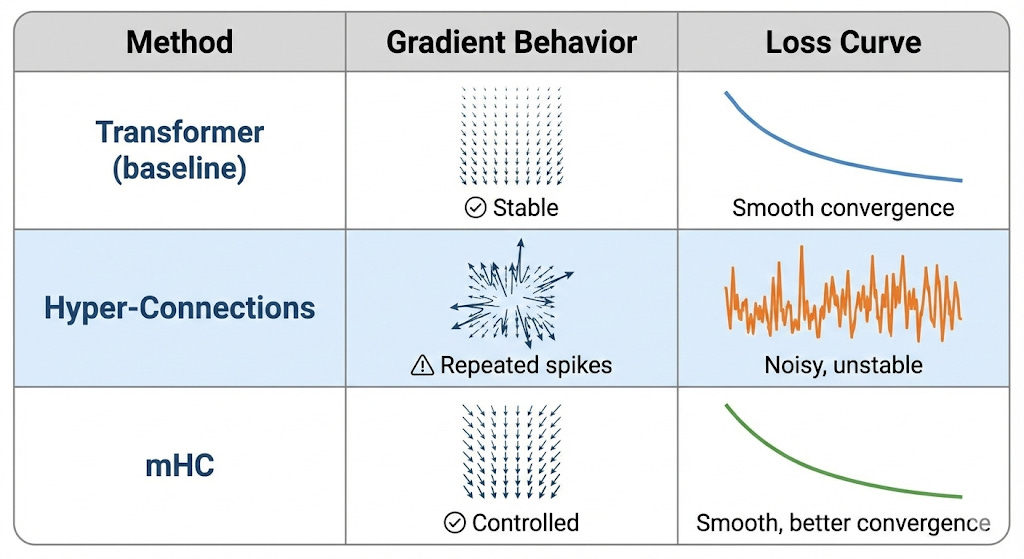
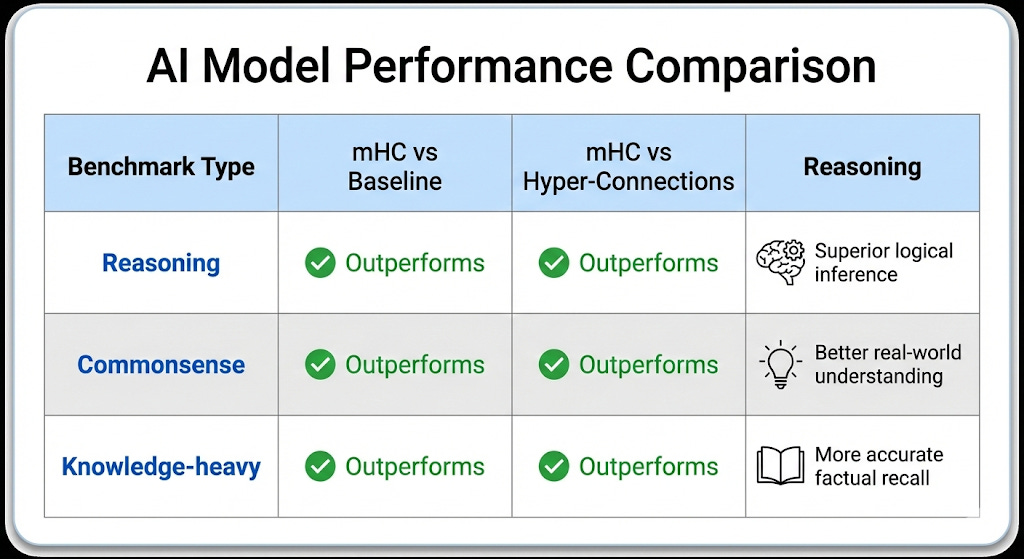
DeepSeek tested mHC against standard Transformers and unconstrained Hyper-Connections at 27B scale.
Training Stability
Downstream Performance (27B model, 8 benchmarks)
Scaling Behavior (3B → 9B → 27B)
The performance advantage of mHC persists as scale increases—a critical result, since many architectural innovations degrade at larger scales.
Why This Matters for Your ML Career
1. Constraints > Complexity
The instinct is always to add flexibility. DeepSeek shows that structured constraints often outperform unconstrained expressivity.
Interview application: When asked about scaling challenges, discuss architectural invariants—not just hyperparameter tuning.
2. Fundamentals Compound
Residual connections are a decade old. This paper revisits them and finds new insights. The engineers who master fundamentals deeply—not just superficially—are the ones making breakthroughs.
Career application: Don’t chase every new architecture. Understand why the classics work.
3. Scale Exposes Everything
Hyper-Connections worked at small scale. They failed at large scale. This pattern repeats constantly in production ML.
System design application: Always ask “What breaks at 10x scale?” before committing to an architecture.
The Mental Model to Remember
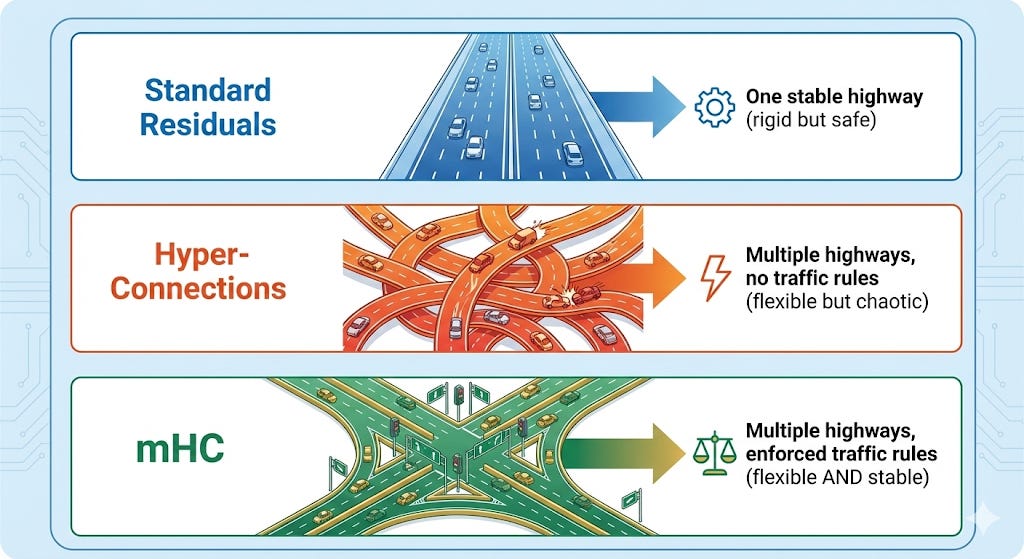
The lesson: Progress isn’t always about adding capabilities. Sometimes it’s about adding the right constraints—constraints that encode what we already know about how deep networks survive scale.
🎯 Your Action Item
Next time you’re designing a system or debugging a failure, ask:
“What invariant am I violating? What constraint could restore it?”
The answer might be simpler—and more powerful—than you expect.
What’s one “boring” fundamental that’s saved you in production? Hit reply—I read every response.
Want help translating deep technical knowledge into interview-winning narratives? Book a coaching session and let’s build your standout story.