

A colleague messages you: “The numbers look wrong this morning. Do you know why?”
You answer without thinking: “I don’t know, ask ___.”
For this article’s purpose, we will call him Bob.
The AI your company rolled out this year does not know what Bob knows.

I have seen this in many organizations over 10 years. A database starts as one tech person’s idea. They build it, maintain it, know the exact codes to pull for each question and who to call when something is blocked. Sometimes they hold the only credentials that get the data out. Every request goes through them. Nothing is written anywhere.
Every AI agent we point at that data is wrong in exactly the way Bob would catch in 2 seconds.
I am someone’s Bob too. Years after I left a job, my old manager still calls. The new hires have my documentation and still cannot reproduce the results. The steps were written down. What I checked before trusting a number was not. That is what we get out of Bob today.

When MIT asked why 95% of company AI projects show no return, the answer was not the models. It was systems that DO NOT HOLD CONTEXT AND DO NOT LEARN.
Think about it:
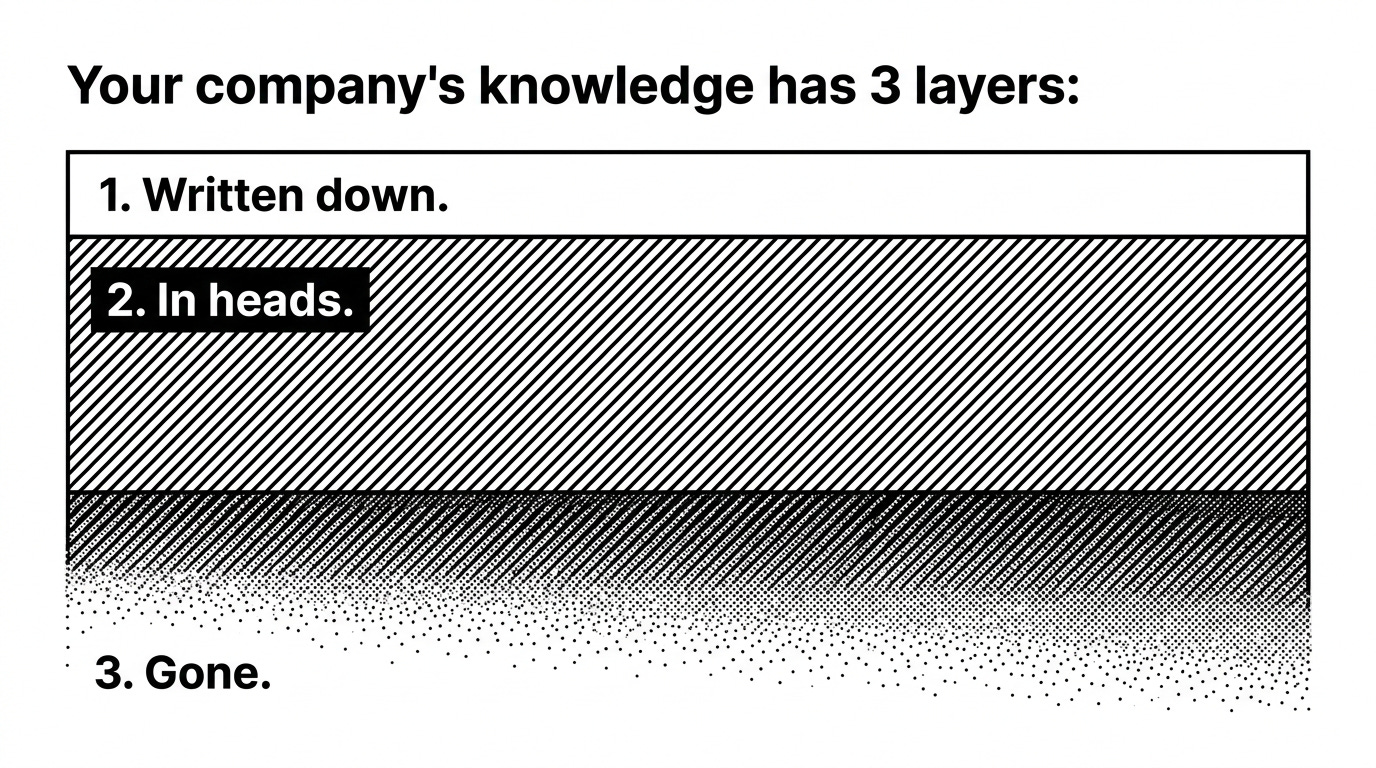
You cannot recover the 3rd.
We can recover the 2nd (In heads) and there are very specific ways this can be done correctly.
Today, you will learn the correct ways to take the information from people’s heads, so you don’t have to bother Bob when he is on vacation, sipping mojitos on the beach.
No one gets promoted for asking Bob. The person who wrote the runbook is the one who gets asked to build what comes next.
Step 1 is free: who is Bob, and where to draw the line. Steps 2 to 5 are for paid subscribers: the script that gets Bob talking, the 5 questions, and the prompt that writes the runbook for you.
Step 1: Pick your Bob and the year

Find the 5 questions your team messages Bob about.
You want the actual questions - and some of these might be only in the 1:1 meetings with Bob.
Another way is to export the last 6 months of the channel where people ask Bob (Slack, Teams, the shared inbox; most tools export to a file in 2 clicks, and check your company's rules before you export anything with names in it). Give the file to your AI tool with this prompt:
This is 6 months of messages from my team channel. Find every question
addressed to [Bob’s name] or answered by him. Group the ones that are
the same question asked in different words. Return the 5 groups asked
most often, with: the question in one line, how many times it was
asked, and the dates of the first and last time.
Examples of questions only Bob can answer:
