

Your company bought and integrated AI in their ecosystem. I have some questions for you:
Have you had less meetings?
Have you written less reports because AI writes them automatically?
And the most important one: Did you go home earlier this year?
Let’s start with some numbers. By middle of 2025, companies put $30 to $40 Billions into Generative AI (GenAI). An MIT study of 300 deployments found that for 95% of them, the GenAI adoption changed nothing in their profit numbers.
Only 5% companies saw a difference in profit.
And it is not because companies did not buy enough. In one year, the share of AI work done on company-approved accounts went from 25% to 62%.
9 in 10 companies now use AI somewhere in the business. And when McKinsey asked them this August, the share of companies that see any effect on profit was the same as in 2025 (5%).
Companies bought the tool. But everything else stayed the same.
So what is going on? It seems like it is NOT a technology problem. The models are far ahead of how companies use them. It is a layout problem. Let me explain with a story from 1900, because we have been here before.
New motor, same old floor plan
In 1880, the floor plan of an entire factory was decided by one thing: How far you a machine was from the shaft.
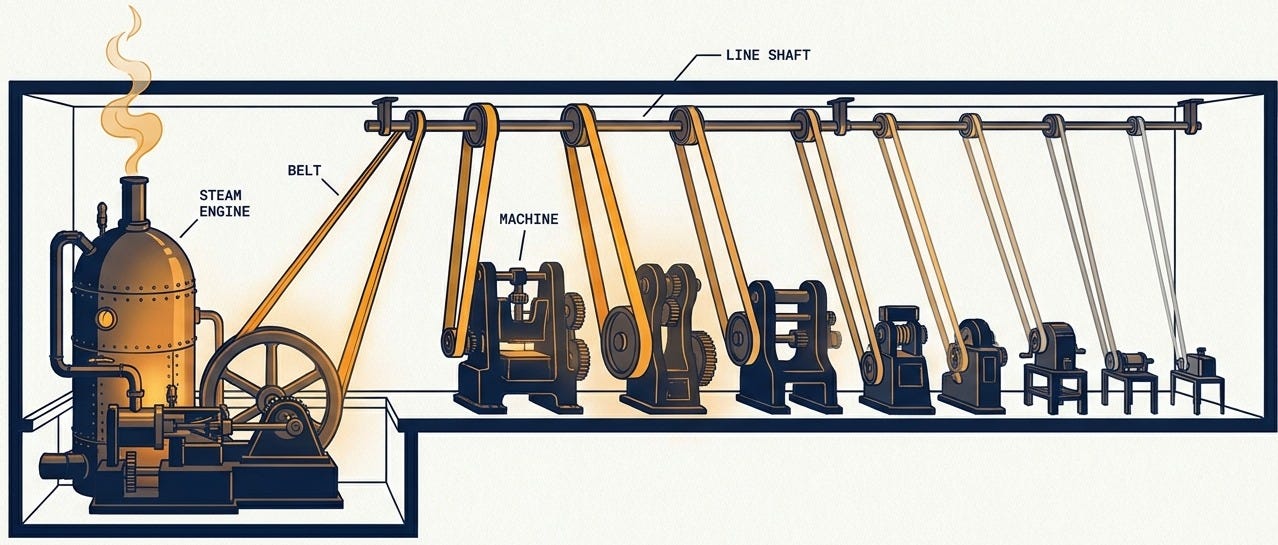
Typically, a factory would have one giant steam engine in the basement. A shaft would run through the building and every machine would connect to that shaft with a belt. The rule was simple: the machines that needed the most power had to sit closest to the engine.
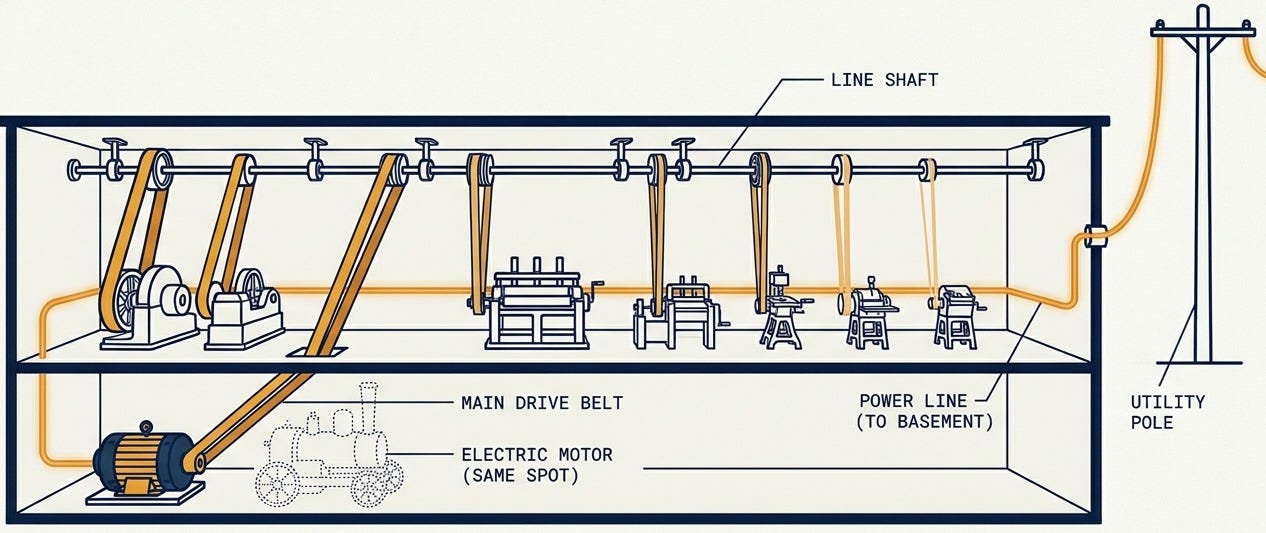
Then electricity arrived. What did the factory owners do? They took out the steam engine and put a big electric motor in the same place. Same shaft. Same belts. Same floor plan. People did not consider changing the floor plan with the new technology in mind.
Think about it. The constraint was gone. Power could go anywhere in the building.
But nothing changed. Of course, productivity did not grow either.
Paul David, an economist at Stanford, wrote the famous paper about this in 1990. It took ~40 years from the first electric motor until electricity showed up in the productivity numbers.
What changed after 40 years? Ford's Highland Park plant put the car on a moving line and arranged the workers around the work, not around the power source. The time to build a Model T went from 12.5 hours to 93 minutes. The price of the car dropped. Ford more than doubled the salaries, to 5 dollars a day.
Same electricity. New floor plan.
Translating this to 2026: McKinsey surveyed 1,719 companies in 97 countries and found the ones that make real profit from AI: 6% of them.
3 out of 4 of these 6% had fundamentally redesigned how the work flows.
The 1880s factory's floor plan was built around one constraint: distance to the engine.
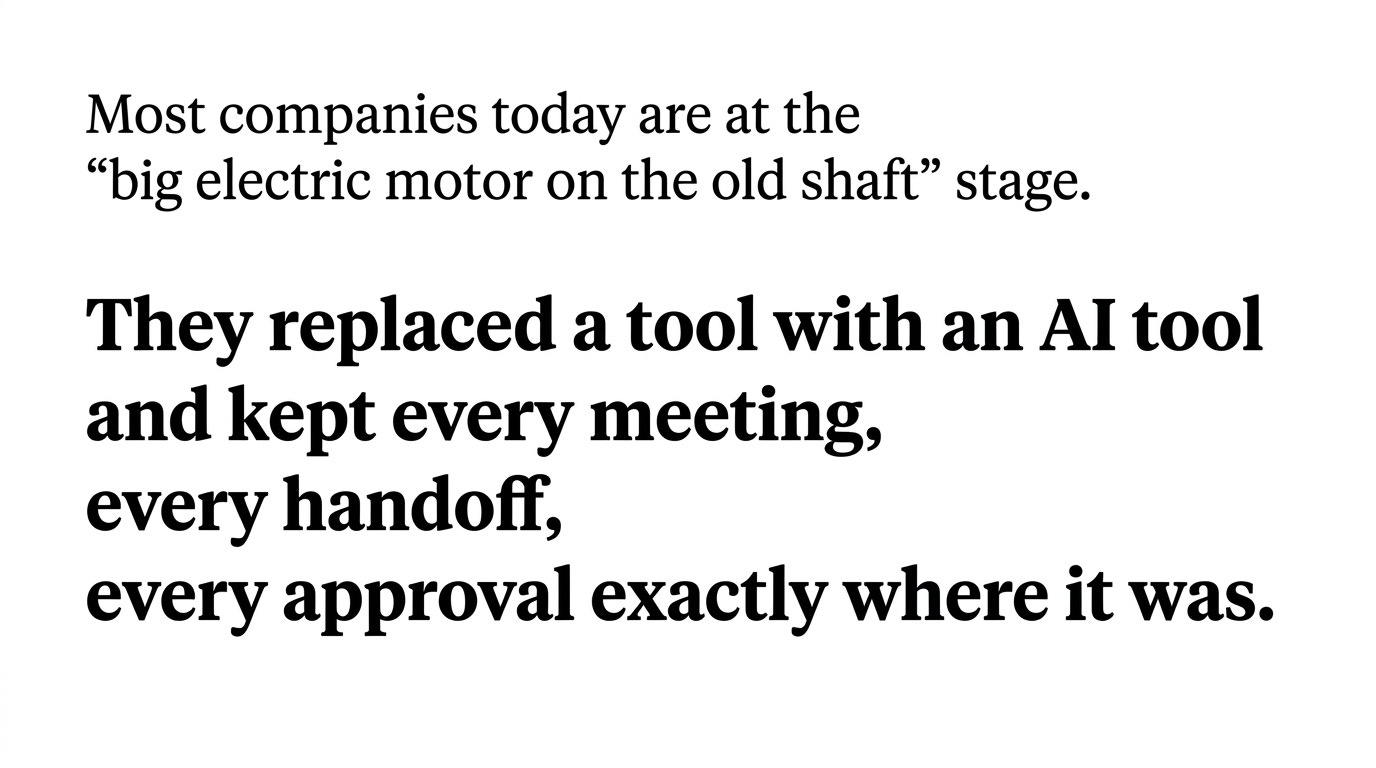
In 2026, your company's floor plan (the meetings, the handoffs, the approvals, the org chart) was built around a different constraint: production.
AI is the electricity in this story. It made production almost free for anything digital: code, drafts, analyses, summaries. The old constraint is gone.
What is expensive now is judgment: who decides what is good enough, who owns the result, who catches the error before a customer (or a patient) does.
But the meetings, the handoffs, and the approvals are still standing where they stood, arranged around a constraint that no longer exists.
Here are 3 moves that you can do to operate under judgement constrained not under production constraint:
Move 1: Find the shaft
Take one process your team repeats every week: the weekly report, a release, a client update.
Write down every step, one per line.
Now imagine the work itself took one hour instead of 3 days.
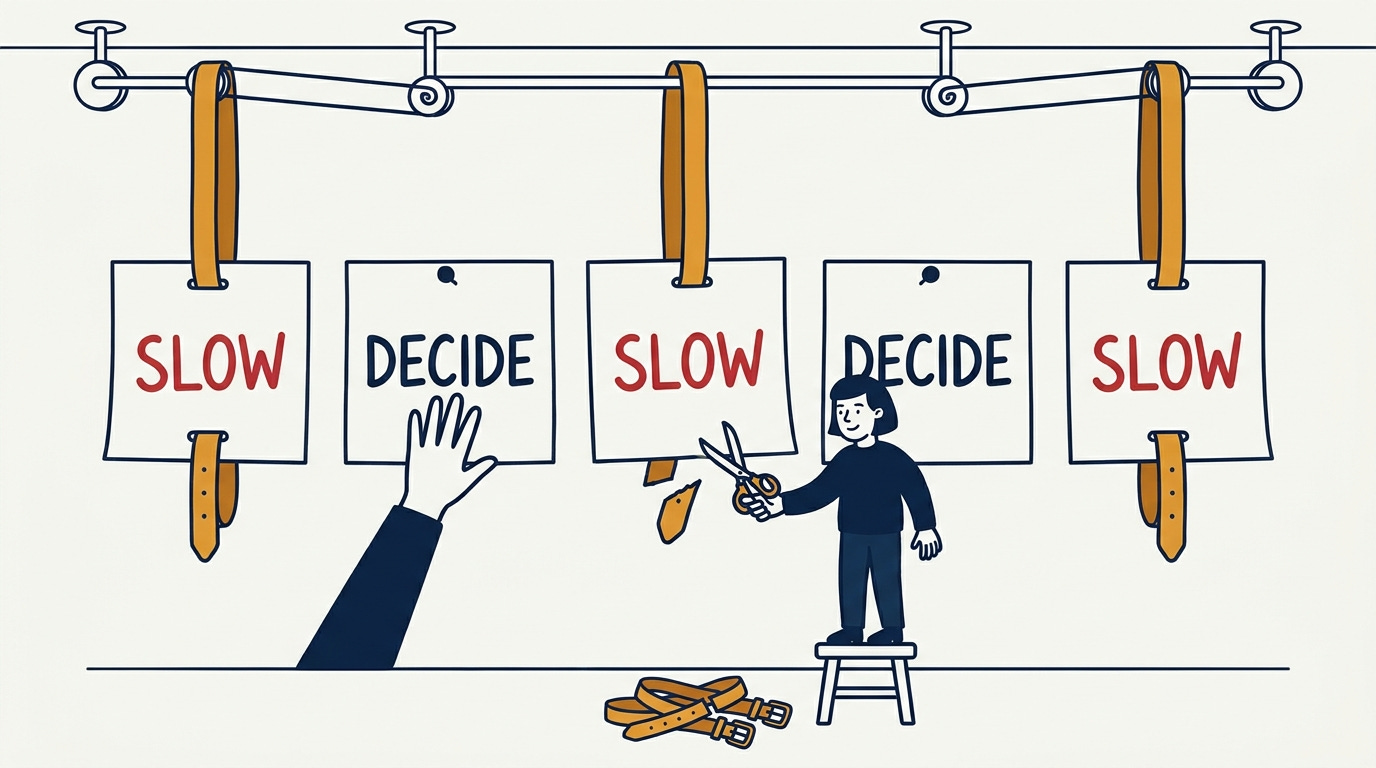
Go down your list and ask about each step: Would we still need this?
Every step has one of two reasons to exist:
Either the work was SLOW, or someone has to DECIDE.
These are the 2 words you will write next to each step.
Some steps would disappear:
The Monday status meeting. 6 people spend 30 minutes telling each other how far along the report is. This meeting exists because the report took 1 week to write, so people needed updates along the way. When the draft takes 1 hour, you don’t need the status meeting anymore.
The handoff. In the old days, the analyst pulls the numbers on Tuesday and emails them to the writer, who builds the slides on Thursday. The handoff exists because one person could not do both in the time available. But with AI, we don’t need multiple people - the analyst can ask an AI agent to build the slides.
The waiting queue. You ask the data team for one number and get it in f5 days, because 12 requests sit ahead of yours. The queue exists because every answer cost hours of a scarce person. When the answer takes 1 minute, there is nothing to queue for.
You will see that many of these steps exist only because making things was SLOW. Because of AI, making is not slow anymore. Delete them.
Do it now:
Take one process that you are running.
Break it up into steps.
Next to each step write SLOW or DECIDE.
Write the hours/days that it takes now and what you expect, next to every SLOW.
Move 2: Decide what AI decides
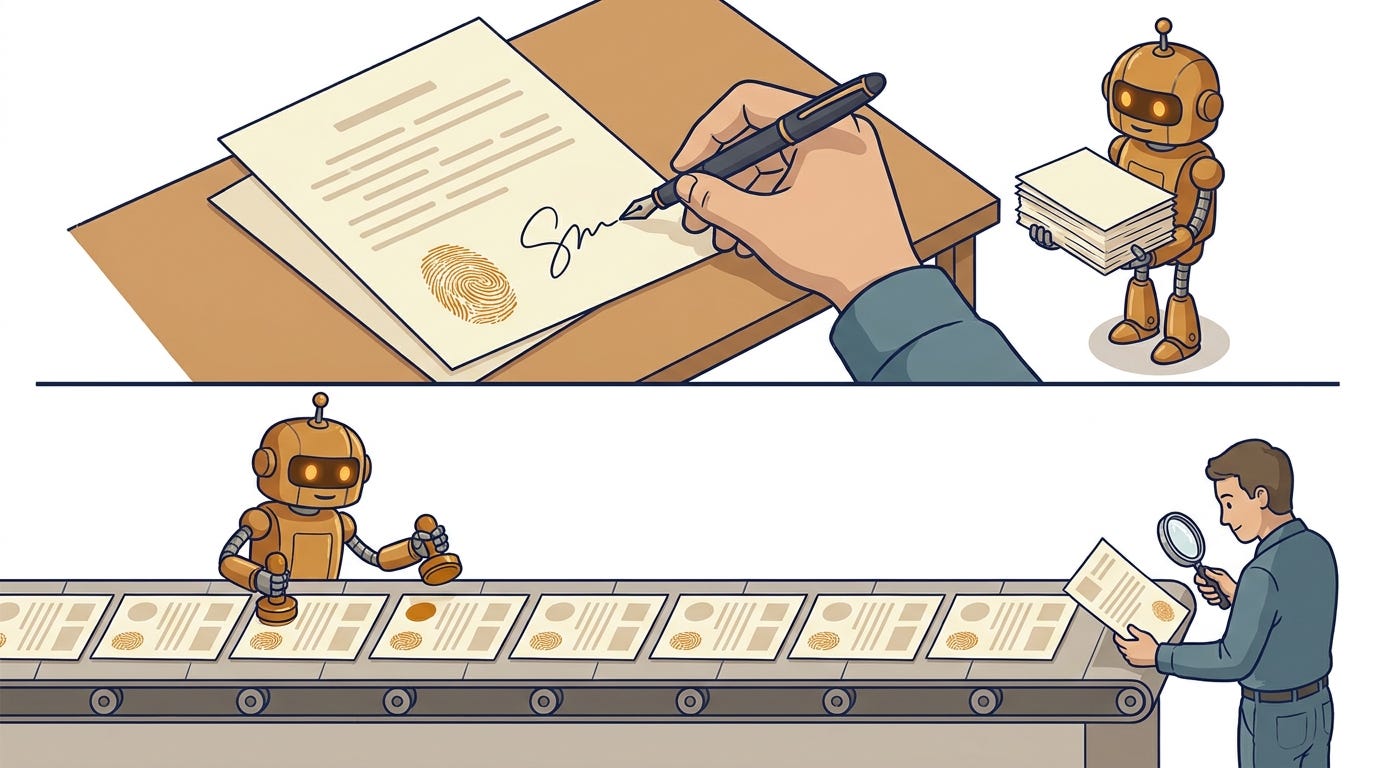
Under the production constraint, every decision waited for a person, because a person was making the thing anyway.
Under the judgment constraint, you choose.
In my field the line is drawn for me. A model drafts the validation report in an afternoon. A named person signs it and answers to the FDA for it.
Do it now: Finish these 2 sentences for your process:
AI decides when ___.
A named person decides when ___.
Move 3: Keep the reason, not only the result

Judgment runs on reasons.
When making was slow, the reasons got written down, because the document was the work.
Now the result arrives in an afternoon and the reason evaporates.
A product team I know stopped writing specs and shipped straight from AI chats. 6 months later someone asked: Why a feature was built that way? The answer was in a chat window closed in March.
Do it now: For the last thing you shipped with AI, write one paragraph:
What we built, why, what we rejected and why.
You can’t rewire your whole company. But you can decide on one process you are working on this week.
I help ambitious and smart professionals (scientists, engineers, tech people, and not only) thrive in their careers. If your team has 50AI projects and zero moved desks, you don’t have to redraw the floor plan alone.
Would it be a bad idea to try one of these 3 moves this week? Tell me which one in the comments.
Teodora
I’m Dr. Teodora Szasz. By day I build AI that has to pass regulators.. In my second practice I advise teams shipping AI that has to be trusted, and coach AI/ML engineers and scientists on getting the role, the title, and the pay their work deserves.
Now if only the LLMs could keep up and do dialectical materialism like a human can, or at least some of them who weren't raised to believe in a figment of their imagination. It would be nice if an LLM understood real world constraints for a change, but rather than measure any real situation, it just fetches some bias from a political bin involving identity, like it's an answer to anything.
Getting LLMs understand environmental constraints in a garage is about one of the funniest examples of testing I've ever done. It skips the most basic of safety checks because it doesn't think real world context matters. It just assumes it already knows the perfect conditions exist. This stuff has to be laughably funny for most business owners. I gotta think this only works for a limited number of business types that can be profitable.
Non stop fundamental attribution error all day. It even blames my business partner for things he couldn't cause. Like it's trying to start a fight between us.
The narrative this will take everyone's job is hilarious, but what it shows is that engineers and AI companies live in an echo chamber. I doubt they talk to anyone who isn't a corporate stiff, the only world that exists is their own and the internet. The rest of us were forgotten about. We're just over here laughing at the attribution errors.
The 1900 factory comparison is the sharpest framing of this I've seen. The tell for me is that the 'floor plan' is usually undocumented: nobody can say who owns a decision or where an input comes from, so there's nothing for the AI to attach to. That's less a tooling gap than a structure gap, and it would explain why the 5% look like the teams that redrew the workflow first.